II. From AGI to Superintelligence
II. 从 AGI 到超级智能
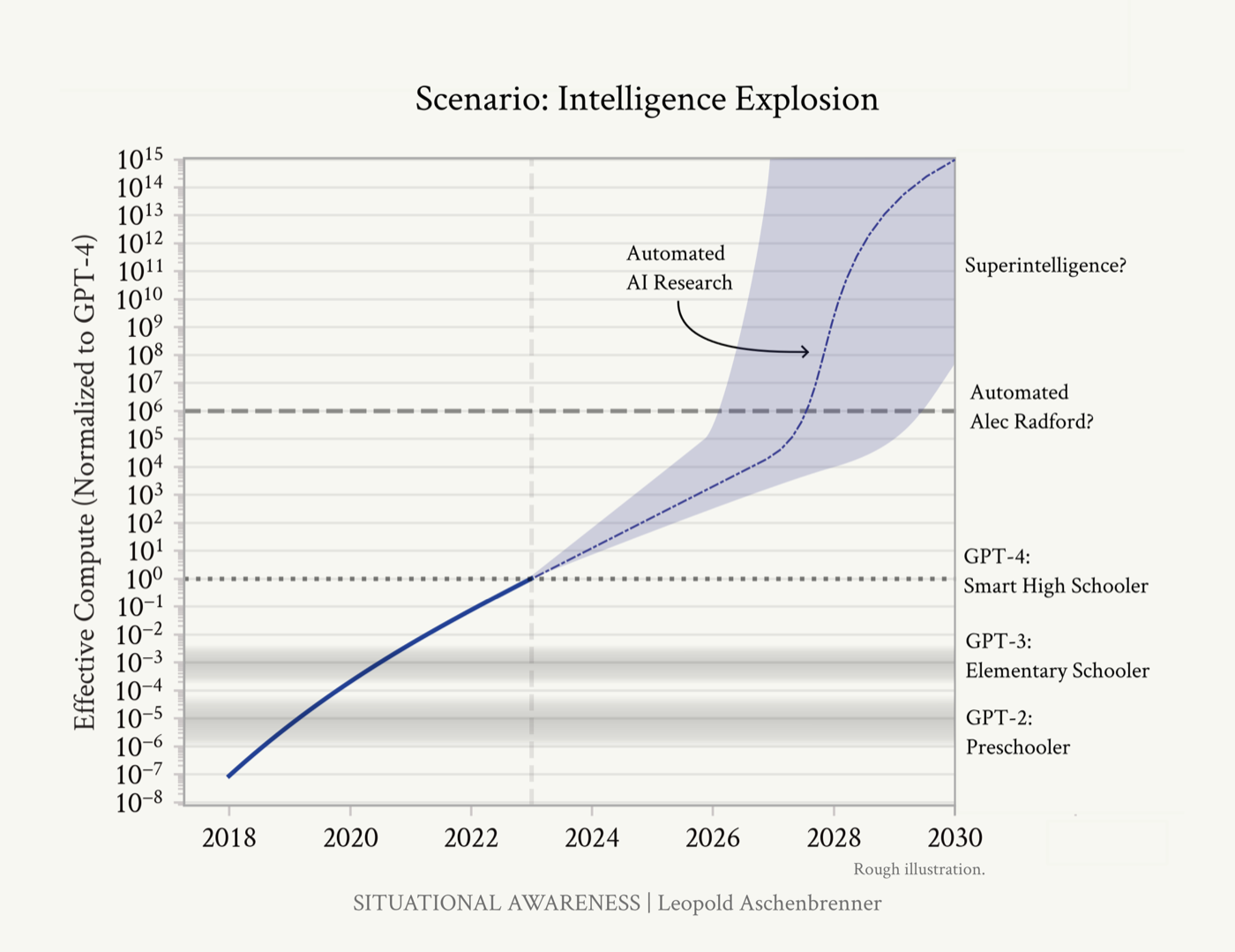
**AI progress won’t stop at human-level. Hundreds of millions of AGIs could automate AI research, compressing a decade of algorithmic progress (5+ OOMs) into ≤1 year. We would rapidly go from human-level to vastly superhuman AI systems. The power—and the peril—of superintelligence would be dramatic. **
In this piece: Toggle
Let an ultraintelligent machine be defined as a machine that can far surpass all the intellectual activities of any man however clever. Since the design of machines is one of these intellectual activities, an ultraintelligent machine could design even better machines; there would then unquestionably be an ‘intelligence explosion,’ and the intelligence of man would be left far behind. Thus the first ultraintelligent machine is the last invention that man need ever make.
I. J. Good (**1965*)* I. J. Good(1965) The Bomb and The Super
In the common imagination, the Cold War’s terrors principally trace back to Los Alamos, with the invention of the atomic bomb. But The Bomb, alone, is perhaps overrated. Going from The Bomb to The Super—hydrogen bombs—was arguably just as important.
In the Tokyo air raids, hundreds of bombers dropped thousands of tons of conventional bombs on the city. Later that year, Little Boy, dropped on Hiroshima, unleashed similar destructive power in a single device. But just 7 years later, Teller’s hydrogen bomb multiplied yields a thousand-fold once again—a single bomb with more explosive power than all of the bombs dropped in the entirety of WWII combined.
The Bomb was a more efficient bombing campaign. The Super was a country-annihilating device.1
So it will be with AGI and Superintelligence.
AI progress won’t stop at human-level. After initially learning from the best human games, AlphaGo started playing against itself—and it quickly became superhuman, playing extremely creative and complex moves that a human would never have come up with.
We discussed the path to AGI in the previous piece. Once we get AGI, we’ll turn the crank one more time—or two or three more times—and AI systems will become superhuman—vastly superhuman. They will become qualitatively smarter than you or I, much smarter, perhaps similar to how you or I are qualitatively smarter than an elementary schooler.
The jump to superintelligence would be wild enough at the current rapid but continuous rate of AI progress (if we could make the jump to AGI in 4 years from GPT-4, what might another 4 or 8 years after that bring?). But it could be much faster than that, if AGI automates AI research itself.
Once we get AGI, we won’t just have one AGI. I’ll walk through the numbers later, but: given inference GPU fleets by then, we’ll likely be able to run many millions of them (perhaps 100 million human-equivalents, and soon after at 10x+ human speed). Even if they can’t yet walk around the office or make coffee, they will be able to do ML research on a computer. Rather than a few hundred researchers and engineers at a leading AI lab, we’d have more than 100,000x that—furiously working on algorithmic breakthroughs, day and night. Yes, recursive self-improvement, but no sci-fi required; *they would need only to accelerate the existing trendlines of algorithmic progress (currently at ~0.5 OOMs/year). *
**Automated AI research could accelerate algorithmic progress, leading to 5+ OOMs of effective compute gains in a year. The AI systems we’d have by the end of an intelligence explosion would be vastly smarter than humans. **
Automated AI research could probably compress a human-decade of algorithmic progress into less than a year (and that seems conservative). That’d be 5+ OOMs, another GPT-2-to-GPT-4-sized jump, on top of AGI—a qualitative jump like that from a preschooler to a smart high schooler, on top of AI systems already as smart as expert AI researchers/engineers.
There are several plausible bottlenecks—including limited compute for experiments, complementarities with humans, and algorithmic progress becoming harder—which I’ll address, but none seem sufficient to definitively slow things down.
Before we know it, we would have superintelligence on our hands—AI systems *vastly *smarter than humans, capable of novel, creative, complicated behavior we couldn’t even begin to understand—perhaps even a small civilization of billions of them. Their power would be vast, too. Applying superintelligence to R&D in other fields, explosive progress would broaden from just ML research; soon they’d solve robotics, make dramatic leaps across other fields of science and technology within years, and an industrial explosion would follow. Superintelligence would likely provide a decisive military advantage, and unfold untold powers of destruction. We will be faced with one of the most intense and volatile moments of human history.
Automating AI research
We don’t need to automate everything—just AI research. A common objection to transformative impacts of AGI is that it will be hard for AI to do everything. Look at robotics, for instance, doubters say; that will be a gnarly problem, even if AI is cognitively at the levels of PhDs. Or take automating biology R&D, which might require lots of physical lab-work and human experiments.
But we don’t need robotics—we don’t need many things—for AI to automate AI research. The jobs of AI researchers and engineers at leading labs can be done fully virtually and don’t run into real-world bottlenecks in the same way (though it will still be limited by compute, which I’ll address later). And the job of an AI researcher is fairly straightforward, in the grand scheme of things: read ML literature and come up with new questions or ideas, implement experiments to test those ideas, interpret the results, and repeat. This all seems squarely in the domain where simple extrapolations of current AI capabilities could easily take us to or beyond the levels of the best humans by the end of 2027.2
It’s worth emphasizing just how straightforward and hacky some of the biggest machine learning breakthroughs of the last decade have been: "oh, just add some normalization" (LayerNorm/BatchNorm) or "do f(x)+x instead of f(x)" (residual connections)" or "fix an implementation bug" (Kaplan → Chinchilla scaling laws). AI research can be automated. And automating AI research is all it takes to kick off extraordinary feedback loops.3
We’d be able to run millions of copies (and soon at 10x+ human speed) of the automated AI researchers. Even by 2027, we should expect GPU fleets in the 10s of millions. Training clusters alone should be approaching ~3 OOMs larger, already putting us at 10 million+ A100-equivalents. Inference fleets should be much larger still. (More on all this in a later piece.)
That would let us run many millions of copies of our automated AI researchers, perhaps 100 million human-researcher-equivalents, running day and night. There’s some assumptions that flow into the exact numbers, including that humans "think" at 100 tokens/minute (just a rough order of magnitude estimate, e.g. consider your internal monologue) and extrapolating historical trends and Chinchilla scaling laws on per-token inference costs for frontier models remaining in the same ballpark.4 We’d also want to reserve some of the GPUs for running experiments and training new models. Full calculation in a footnote.5
Another way of thinking about it is that given inference fleets in 2027, we should be able to generate an entire internet’s worth of tokens, every single day.6 In any case, the exact numbers don’t matter that much, beyond a simple plausibility demonstration.
Moreover, our automated AI researchers may soon be able to run at much faster than human-speed:
- By taking some inference penalties, we can trade off running fewer copies in exchange for running them at faster serial speed. (For example, we could go from ~5x human speed to ~100x human speed by "only" running 1 million copies of the automated researchers.7)
- More importantly, the first algorithmic innovation the automated AI researchers work on is getting a 10x or 100x speedup. Gemini 1.5 Flash is ~10x faster than the originally-released GPT-4,8 merely a year later, while providing similar performance to the originally-released GPT-4 on reasoning benchmarks. If that’s the algorithmic speedup a few hundred human researchers can find in a year, the automated AI researchers will be able to find similar wins very quickly.
*That is: expect 100 million automated researchers each working at 100x human speed not long after we begin to be able to automate AI research. *They’ll each be able to do a year’s worth of work in a few days. The increase in research effort—compared to a few hundred puny human researchers at a leading AI lab today, working at a puny 1x human speed—will be extraordinary.
This could easily dramatically accelerate existing trends of algorithmic progress, compressing a decade of advances into a year. We need not postulate anything totally novel for automated AI research to intensely speed up AI progress. Walking through the numbers in the previous piece, we saw that algorithmic progress has been a central driver of deep learning progress in the last decade; we noted a trendline of ~0.5 OOMs/year on algorithmic efficiencies alone, with additional large algorithmic gains from unhobbling on top. (I think the import of algorithmic progress has been underrated by many, and properly appreciating it is important for appreciating the possibility of an intelligence explosion.)
Could our millions of automated AI researchers (soon working at 10x or 100x human speed) compress the algorithmic progress human researchers would have found in a decade into a year instead? That would be 5+ OOMs in a year.
Don’t just imagine 100 million junior software engineer interns here (we’ll get those earlier, in the next couple years!). Real automated AI researchers will be very smart—and in addition to their raw quantitative advantage, automated AI researchers will have other enormous advantages over human researchers:
- They’ll be able to read every single ML paper ever written, have been able to deeply think about every single previous experiment ever run at the lab, learn in parallel from each of their copies, and rapidly accumulate the equivalent of millennia of experience. They’ll be able to develop far deeper intuitions about ML than any human.
- They’ll be easily able to write millions of lines of complex code, keep the entire codebase in context, and spend human-decades (or more) checking and rechecking every line of code for bugs and optimizations. They’ll be superbly competent at all parts of the job.
- You won’t have to individually train up each automated AI researcher (indeed, training and onboarding 100 million new human hires would be difficult). Instead, you can just teach and onboard one of them—and then make replicas. (And you won’t have to worry about politicking, cultural acclimation, and so on, and they’ll work with peak energy and focus day and night.)
- Vast numbers of automated AI researchers will be able to share context (perhaps even accessing each others’ latent space and so on), enabling much more efficient collaboration and coordination compared to human researchers.
- And of course, however smart our initial automated AI researchers would be, we’d soon be able to make further OOM-jumps, producing even smarter models, even more capable at automated AI research.
Imagine an automated Alec Radford—imagine 100 million automated Alec Radfords.9 I think just about every researcher at OpenAI would agree that if they had 10 Alec Radfords, let alone 100 or 1,000 or 1 million running at 10x or 100x human speed, they could very quickly solve very many of their problems. Even with various other bottlenecks (more in a moment), compressing a decade of algorithmic progress into a year as a result seems very plausible. (A 10x acceleration from a million times more research effort, which seems conservative if anything.)
That would be 5+ OOMs right there. 5 OOMs of algorithmic wins would be a similar scaleup to what produced the GPT-2-to-GPT-4 jump, a capability jump from ~a preschooler to ~a smart high schooler. Imagine such a qualitative jump *on top of *AGI, on top of Alec Radford.
It’s strikingly plausible we’d go from AGI to superintelligence very quickly, perhaps in less than one year.
Possible bottlenecks
While this basic story is surprisingly strong—and is supported by thorough economic modeling work—there are some real and plausible bottlenecks that will probably slow down an automated-AI-research intelligence explosion.
I’ll give a summary here, and then discuss these in more detail in the optional sections below for those interested:
- Limited compute: AI research doesn’t just take good ideas, thinking, or math—but running experiments to get empirical signal on your ideas. A million times more research effort via automated research labor won’t mean a million times faster progress, because compute will still be limited—and limited compute for experiments will be the bottleneck. Still, even if this won’t be a 1,000,000x speedup, I find it hard to imagine that the automated AI researchers couldn’t use the compute *at least *10x more effectively: they’ll be able to get incredible ML intuition (having internalized the whole ML literature and every previous experiment every run!) and centuries-equivalent of thinking-time to figure out exactly the right experiment to run, configure it optimally, and get the maximum value of information; they’ll be able to spend centuries-equivalent of engineer-time before running even tiny experiments to avoid bugs and get them right on the first try; they can make tradeoffs to economize on compute by focusing on the biggest wins; and they’ll be able to try tons of smaller-scale experiments (and given effective compute scaleups by then, "smaller-scale" means being able to train 100,000 GPT-4-level models in a year to try architecture breakthroughs). Some human researchers and engineers are able to produce 10x the progress as others, even with the same amount of compute—and this should apply even moreso to automated AI researchers. I do think this is the most important bottleneck, and I address it in more depth below.
- Complementarities/long tail*: *A classic lesson from economics (cf Baumol’s growth disease) is that if you can automate, say, 70% of something, you get some gains but quickly the remaining 30% become your bottleneck. For anything that falls short of full automation—say, really good copilots—human AI researchers would remain a major bottleneck, making the overall increase in the rate of algorithmic progress relatively small. Moreover, there’s likely some long tail of capabilities required for automating AI research—the last 10% of the job of an AI researcher might be particularly hard to automate. This could soften takeoff some, though my best guess is that this only delays things by a couple years. Perhaps 2026/27-models speed are the proto-automated-researcher, it takes another year or two for some final unhobbling, a somewhat better model, inference speedups, and working out kinks to get to full automation, and finally by 2028 we get the 10x acceleration (and superintelligence by the end of the decade).
- Inherent limits to algorithmic progress*: *Maybe another 5 OOMs of algorithmic efficiency will be fundamentally impossible? I doubt it. While there will definitely be upper limits,10 if we got 5 OOMs in the last decade, we should probably expect at least another decade’s-worth of progress to be possible. More directly, current architectures and training algorithms are still very rudimentary, and it seems that much more efficient schemes should be possible. Biological reference classes also support dramatically more efficient algorithms being plausible.
- ***Ideas get harder to find, so the automated AI researchers will merely sustain, rather than accelerate, the current rate of progress: ***One objection is that although automated research would increase effective research effort a lot, ideas also get harder to find. That is, while it takes only a few hundred top researchers at a lab to sustain 0.5 OOMs/year today, as we exhaust the low-hanging fruit, it will take more and more effort to sustain that progress—and so the 100 million automated researchers will be merely what’s necessary to sustain progress. I think this basic model is correct, but the empirics don’t add up: the magnitude of the increase in research effort—a million-fold—is way, way larger than the historical trends of the growth in research effort that’s been necessary to sustain progress. In econ modeling terms, it’s a bizarre "knife-edge assumption" to assume that the increase in research effort from automation will be just enough to keep progress constant.
- Ideas get harder to find and there are diminishing returns, so the intelligence explosion will quickly fizzle*: *Related to the above objection, even if the automated AI researchers lead to an initial burst of progress, whether rapid progress can be sustained depends on the shape of the diminishing returns curve to algorithmic progress. Again, my best read of the empirical evidence is that the exponents shake out in favor of explosive/accelerating progress. In any case, the sheer size of the one-time boost—from 100s to 100s of millions of AI researchers—probably overcomes diminishing returns here for at least a good number of OOMs of algorithmic progress, even though it of course can’t be indefinitely self-sustaining.
** Limited compute for experiments
The production function for algorithmic progress includes two complementary factors of production: research effort and experiment compute. The millions of automated AI researchers won’t have any more compute to run their experiments on than human AI researchers; perhaps they’ll just be sitting around waiting for their jobs to finish.
This is probably the most important bottleneck to the intelligence explosion. Ultimately this is a quantitative question—just how much of a bottleneck is it? On balance, I find it hard to believe that the 100 million Alec Radfords couldn’t increase the marginal product of experiment compute by at least 10x (and thus, would still accelerate the pace of progress by 10x):
- There’s a lot you can do with smaller amounts of compute. The way most AI research works is that you test things out at small scale—and then extrapolate via scaling laws. (Many key historical breakthroughs required only a very small amount of compute, e.g. the original Transformer was trained on just 8 GPUs for a few days.) And note that with ~5 OOMs of baseline scaleup in the next four years, "small scale" will mean GPT-4 scale—the automated AI researchers will be able to run 100,000 GPT-4-level experiments on their training cluster in a year, and tens of millions of GPT-3-level experiments. (That’s a lot of potential-breakthrough new architectures they’ll be able to test!)
- A lot of the compute goes into larger-scale validation of the final pretraining run—making sure you are getting a high-enough degree of confidence on marginal efficiency wins for your annual headline product—but if you’re racing through the OOMs in the intelligence explosion, you could economize and just focus on the really big wins.
- As discussed in the previous piece, there are often enormous gains to be had from relatively low-compute "unhobbling" of models. These don’t require big pretraining runs. It’s highly plausible that that intelligence explosion starts off automated AI research e.g. discovering a way to do RL on top that gives us a couple OOMs via unhobbling wins (and then we’re off to the races).
- *As the automated AI researchers find efficiencies, that’ll let them run more experiments. *Recall the near-1000x cheaper inference in two years for equivalent-MATH performance, and the 10x general inference gains in the last year, discussed in the previous piece, from mere-human algorithmic progress. The first thing the automated AI researchers will do is quickly find similar gains, and in turn, that’ll let them run 100x more experiments on e.g. new RL approaches. Or they’ll be able to quickly make smaller models with similar performance in relevant domains (cf previous discussion of Gemini Flash, near-100x cheaper than GPT-4), which in turn will let them run many more experiments with these smaller models (again, imagine using these to try different RL schemes). There are probably other overhangs too, e.g. the automated AI researchers might be able to quickly develop much better distributed training schemes to utilize all the inference GPUs (probably at least 10x more compute right there). More generally, every OOM of training efficiency gains they find will give them an OOM more of effective compute to run experiments on.
- The automated AI researchers could be way more efficient. It’s hard to understate how many fewer experiments you would have to run if you just got it right on the first try—no gnarly bugs, being more selective about exactly what you are running, and so on. Imagine 1000 automated AI researchers spending a month-equivalent checking your code and getting the exact experiment right before you press go. I’ve asked some AI lab colleagues about this and they agreed: you should pretty easily be able to save 3x-10x of compute on most projects merely if you could avoid frivolous bugs, get things right on the first try, and only run high value-of-information experiments.
- The automated AI researchers could have way better intuitions.
- Recently, I was speaking to an intern at a frontier lab; they said that their dominant experience over the past few months was suggesting many experiments they wanted to run, and their supervisor (a senior researcher) saying they could already predict the result beforehand so there was no need. The senior researcher’s years of random experiments messing around with models had honed their intuitions about what ideas would work—or not. Similarly, it seems like our AI systems could easily get superhuman intuitions about ML experiments—they will have read the entire machine learning literature, be able to learn from every other experiment result and deeply think about it, they could easily be trained to predict the outcome of millions of ML experiments, and so on. And maybe one of the first things they do is build up a strong basic science of "predicting if this large scale experiment will be successful just after seeing the first 1% of training, or just after seeing the smaller scale version of this experiment", and so on.
- Moreover, beyond really good intuitions about research directions, as Jason Wei has noted, there are incredible returns to having great intuitions on the dozens of hyperparameters and details of an experiment,. Jason calls this ability to get things right on the first try based on intuition "yolo runs". (Jason says, "what I do know is that the people who can do this are surely 10-100x AI researchers.")
Compute bottlenecks will mean a million times more researchers won’t translate into a million times faster research—thus not an overnight intelligence explosion. But the automated AI researchers will have extraordinary advantages over human researchers, and so it seems hard to imagine that they couldn’t also find a way to use the compute at least 10x more efficiently/effectively—and so 10x the pace of algorithmic progress seems eminently plausible.
Some more discussion in the nested collapsible.
** Addressing the best counterargument: what does the track record of ML academia imply about the compute bottleneck?
I’ll take a moment here to acknowledge perhaps the most compelling formulation of the counterargument I’ve heard, by my friend James Bradbury: if more ML research effort would so dramatically accelerate progress, why doesn’t the current academic ML research community, numbering at least in the tens of thousands, contribute more to frontier lab progress? (Currently, it seems like lab-internal teams, of perhaps a thousand in total across labs, shoulder most of the load for frontier algorithmic progress.) His argument is that the reason is that algorithmic progress is compute-bottlenecked: the academics just don’t have enough compute.
Some responses:
- Quality-adjusted, I think academics are probably more in the thousands not tens of thousands (e.g., looking only at the top universities). This probably isn’t substantially more than the labs combined. (And it’s way less than the hundreds of millions of researchers we’d get from automated AI research.)
- Academics work on the wrong things. Up until very recently (and perhaps still today?), the vast majority of the academic ML community wasn’t even working on large language models.
- In terms of strong academics in academia working on large language models, it might be meaningfully fewer than researchers at labs combined?
- Even when the academics do work on things like LLM pretraining, they simply don’t have access to the state-of-the-art—the large accumulated body of knowledge of tons of details on frontier model training inside labs. They don’t know what problems are actually relevant, or can only contribute one-off results that nobody can really do anything with because their baselines were badly tuned (so nobody knows if their thing is actually an improvement).
- Academics are way worse than automated AI researchers: they can’t work at 10x or 100x human speed, they can’t read and internalize every ML paper ever written, they can’t spend a decade checking every line of code, replicate themselves to avoid onboarding-bottlenecks, etc.
Another countervailing example to the academics argument: GDM is rumored to have way more experiment compute than OpenAI, and yet it doesn’t seem like GDM is massively outpacing OpenAI in terms of algorithmic progress.
In general, I expect automated researchers will have a different style of research that plays to their strengths and aims to mitigate the compute bottleneck. *I think it's reasonable to be uncertain how this plays out, but it's unreasonable to be confident it won't be doable for the models to get around the compute bottleneck just because it'd be hard for humans to do so. *
- For example, they could just spend a lot of effort early on building up a basic science of "how to predict large scale results from smaller scale experiments". And I expect there’s a lot that they could do that humans can’t do, e.g. maybe things more like "predicting if this large scale experiment will be successful just after seeing the first 1% of training". This seems pretty doable if you’re a super strong automated researcher with very superhuman intuitions and this can save you a ton of compute.
- When I imagine AI systems automating AI research, I see them as compute-bottlenecked but making up for it in large part by thinking e.g. 1000x more (and faster) than humans would, and thinking at a higher level of quality than humans (e.g. because of the superhuman ML intuitions from being trained to predict the result of millions of experiments). Unless they’re just much worse at thinking than engineering, I think this can make up for a lot, and this would be qualitatively different from academics.
(In addition to experiment compute, there’s the additional bottleneck of eventually needing to run a big training run, something which currently takes months. But you can probably economize on those, doing only a handful during the year of intelligence explosion, taking bigger OOM leaps for each than labs currently do.
Note that while I think this is likely, it’s kind of scary: it means that rather than a fairly continuous series of big models, each somewhat better than the previous generation, downstream model intelligence might be more discrete/discontinuous. We might only do one or a couple of big runs during the intelligence explosion, banking multiple OOMs of algorithmic breakthroughs found at smaller scale for each.
Or you could "spend" 1 out of the 5 OOMs of compute efficiency wins to do a training run in days rather than months.)
** Complementarities and long tails to 100% automation
The classic economist objection to AI automation speeding up economic growth is that different tasks are complementary—and so, for example, automating 80% of what labor humans did in 1800 didn’t lead to a growth explosion or mass unemployment, but the remaining 20% became what all humans did and remained the bottleneck. (See e.g. a model of this here.).
I think the economists’ model here is correct. But a key point is that I’m only talking about one currently-small part of the economy, rather than the economy as a whole. People may well still be getting haircuts normally during this time—robotics might not yet be worked out, AIs for every domain might not yet be worked out, the societal rollout might not yet be worked out, etc.—but they will be able to do AI research. As discussed in the previous piece, I think the current course of AI progress is taking us to essentially drop-in remote workers as intelligent as the smartest humans; as discussed in this piece, the job of an AI researcher seems totally within the scope of what could be fully automated.
Still, in practice, I do expect somewhat of a long tail to get to truly 100% automation even for the job of an AI researcher/engineer; for example, we might first get systems that function almost as an engineer replacement, but still need some amount of human supervision.
In particular, I expect the level of AI capabilities to be somewhat uneven and peaky across domains: it might be a better coder than the best engineers while still having blindspots in some subset of tasks or skills; by the time it’s human-level at whatever its worst at, it’ll already be substantially superhuman at easier domains to train, like coding. (This is part of why I think they’ll be able to use the compute more effectively than human researchers. By the time of 100% automation/the intelligence explosion starting, they’ll already have huge advantages over humans in some domains. This will also have important implications for superalignment down the line, since it means that we’ll have to align systems that are meaningfully superhuman in many domains in order to align even the first automated AI researchers.)
But I wouldn’t expect that phase to last more than a few years; given the pace of AI progress, I think it would likely just be a matter of some additional "unhobbling" (removing some obvious limitation of the models that prevented it from doing the last mile) or another generation of models to get all the way.
Overall, this might soften takeoff some. Rather that 2027 AGI → 2028 Superintelligence, it might look more like:
- 2026/27: Proto-automated-engineer, but blind spots in other areas. Speeds up work by 1.5x-2x already; progress begins gradually accelerating.
- 2027/28: Proto-automated-researchers, can automate >90%. Some remaining human bottlenecks, and hiccups in coordinating a giant organization of automated researchers to be worked out, but this already speeds up progress by 3x+. This quickly does the remaining necessary "unhobbling" takes us the remainder of the way to 100% automation.
- 2028/29: 10x+ pace of progress → superintelligence.
That’s still very fast…
** Fundamental limits to algorithmic progress
There’s probably a real cap on how much algorithmic progress is physically possible. (For example, 25 OOMs of algorithm progress seems impossible, since that would imply being able to train a GPT-4 level system in less than ~10 FLOPs. Though you could get results that would take 25 more OOMs of hardware with current architecture!)
But something like 5 OOMs seems very much in the realm of possibilities; again, that would just require another decade of trend algorithmic efficiencies (not even counting algorithmic gains from unhobbling).
Intuitively, it very much doesn’t seem like we have exhausted all the low-hanging fruit yet, given how simple the biggest breakthroughs are—and how rudimentary and obviously hobbled current architectures and training techniques still seem to be. For example, I think it’s pretty plausible that we’ll bootstrap our way to AGI via AI systems that "think out loud" via chain-of-thought. But surely this isn’t the most efficient way to do it, *surely *something that does this reasoning via internal states/recurrence/etc would be way more efficient. Or consider adaptive compute: Llama 3 still spends as much compute on predicting the "and" token as it does the answer to some complicated question, which seems clearly suboptimal. We’re getting huge OOM algorithmic gains from even just small tweaks, while there are dozens of areas where much more efficient architectures and training procedures could likely be found.
Biological references also suggest huge headroom. The human range of intelligence is very wide, for example, with only tiny tweaks to architecture. Humans have similar numbers of neurons as other animals, even though humans are much smarter than those animals. And current AI models are still many OOMs from the efficiency of a human brain; they can learn with a tiny fraction of the data (and thus tiny fraction of "compute") than AI models can, suggesting huge headroom for our algorithms and architecture.
** Ideas get harder to find and diminishing returns
As you pick the low-hanging fruit, ideas get harder to find. This is true in any domain of technological progress. Essentially, we see a straight line on a log-log curve: log(progress) is a function of log(cumulative research effort). Every OOM of further progress requires putting in more research effort than the last OOM.
This leads to two objections to the intelligence explosion:
- Automated AI research will merely be what’s necessary to sustain progress (rather than dramatically accelerating it).
- A purely-algorithmic intelligence explosion would not be sustained / would quickly fizzle out as algorithmic progress gets harder to find / you hit diminishing marginal returns.
I spent a lot of time thinking about these sorts of models in a past life, when I was doing research in economics. (In particular, semi-endogenous growth theory is the standard model of technological progress, capturing these two competing dynamics of growing research effort and ideas getting harder to find.)
In short, I think the underlying model behind these objections is sound, but how it shakes out is an empirical question—and I think they get the empirics wrong.
The key question is essentially: for every 10x of progress, does further progress become more or less than 10x harder? Napkin math (along the lines of how this is done in the economic literature) helps us bound this.
- Suppose we take the ~0.5 OOMs/year trend rate of algorithmic progress seriously; that implies a 100x of progress in 4 years.
- However, quality-adjusted headcount / research effort at a given leading AI lab has definitely grown by <100x in 4 years. *Maybe *it’s increased 10x (from 10s to 100s of people working on relevant stuff at a given lab), but even that is unclear quality-adjusted.
- And yet, algorithmic progress seems to be sustained.
Thus, in response to objection 1, we can note that the ~million-fold increase in research effort will simply be a much larger increase than what would merely be necessary to sustain progress. Maybe we’d need on the order of thousands of researchers working on relevant research at a lab in 4 years to sustain progress; the 100 million Alec Radfords would still be an enormous increase, and surely lead to massive acceleration. It’s just a bizarre "knife-edge" assumption to think that automated research would be just enough to sustain the existing pace of progress. (And that’s not even counting thinking at 10x human speed and all the other advantages the AI systems will have over human researchers.)
In response to objection 2, we can note two things:
- First, the mathematical condition noted above. Given that, based on our napkin math, quality-adjusted research effort needed to grow <<100x while we did 100x of algorithmic progress, it pretty strongly seems that the shape of the returns curve shakes out in favor of self-sustaining progress. (100x progress → 100x more automated research effort, but you, say, only needed 10x more research effort to keep it going and do the next 100x, so the returns are good enough for explosive progress to be sustained.)
- Secondly, the returns curve doesn’t even need to shake out in favor of a fully sustained chain reaction for us to get a bounded-but-many-OOM surge of algorithmic progress. Essentially, it doesn’t need to be a "growth effect"; a large enough "level effect" would be enough. That is, a million-fold increase in research effort (combined with the many other advantages automated researchers would have over human researchers) would be such a large one-time boost that even if the chain reaction isn’t fully self-sustaining, it could lead to a very sizeable (many OOMs) one-time gain. Analogously, in semi-endogenous economic growth theory, boosting science investment from 1% to 20% of GDP won’t make growth rates higher forever—eventually diminishing returns would lead things to return to the old growth rate—but the "level effect" it would lead to would be so large as to dramatically speed up growth for decades.
On net, while obviously it won’t be unbounded and I have a lot of uncertainty over just how far it’ll go, I think something like a 5 OOM intelligence explosion purely from algorithmic gains / automated AI research seems highly plausible.
Tom Davidson and Carl Shulman have also looked at the empirics of this in a growth-modeling framework and come to similar conclusions. Epoch AI has also done some recent work on the empirics, also coming to the conclusion that empirical returns to algorithmic R&D favors explosive growth, with a helpful writeup of the implications.
Overall, these factors may slow things down somewhat: the most extreme versions of intelligence explosion (say, overnight) seem implausible. And they may result in a somewhat longer runup (perhaps we need to wait an extra year or two from more sluggish, proto-automated researchers to the true automated Alec Radfords, before things kick off in full force). But they certainly don’t rule out a very rapid intelligence explosion. A year—or at most just a few years, but perhaps even just a few months—in which we go from fully-automated AI researchers to vastly superhuman AI systems should be our mainline expectation.
The power of superintelligence
Whether or not you agree with the strongest form of these arguments—whether we get a <1 year intelligence explosion, or it takes a few years—it is clear: we must confront the possibility of superintelligence.
The AI systems we’ll likely have by the end of this decade will be unimaginably powerful.
- Of course, they’ll be *quantitatively *superhuman. On our fleets of 100s of millions of GPUs by the end of the decade, we’ll be able to run a civilization of billions of them, and they will be able to "think" orders of magnitude faster than humans. They’ll be able to quickly master any domain, write trillions of lines of code, read every research paper in every scientific field ever written (they’ll be perfectly interdisciplinary!) and write new ones before you’ve gotten past the abstract of one, learn from the parallel experience of every one of its of copies, gain billions of human-equivalent years of experience with some new innovation in a matter of weeks, work 100% of the time with peak energy and focus and won’t be slowed down by that one teammate who is lagging, and so on.
- More importantly—but harder to imagine—they’ll be qualitatively superhuman. As a narrow example of this, large-scale RL runs have been able to produce completely novel and creative behaviors beyond human understanding, such as the famous move 37 in AlphaGo vs. Lee Sedol. Superintelligence will be this across many domains. It’ll find exploits in the human code too subtle for any human to notice, and it’ll generate code too complicated for any human to understand even if the model spent decades trying to explain it. Extremely difficult scientific and technological problems that a human would be stuck on for decades will seem just so obvious to them. We’ll be like high-schoolers stuck on Newtonian physics while it’s off exploring quantum mechanics.
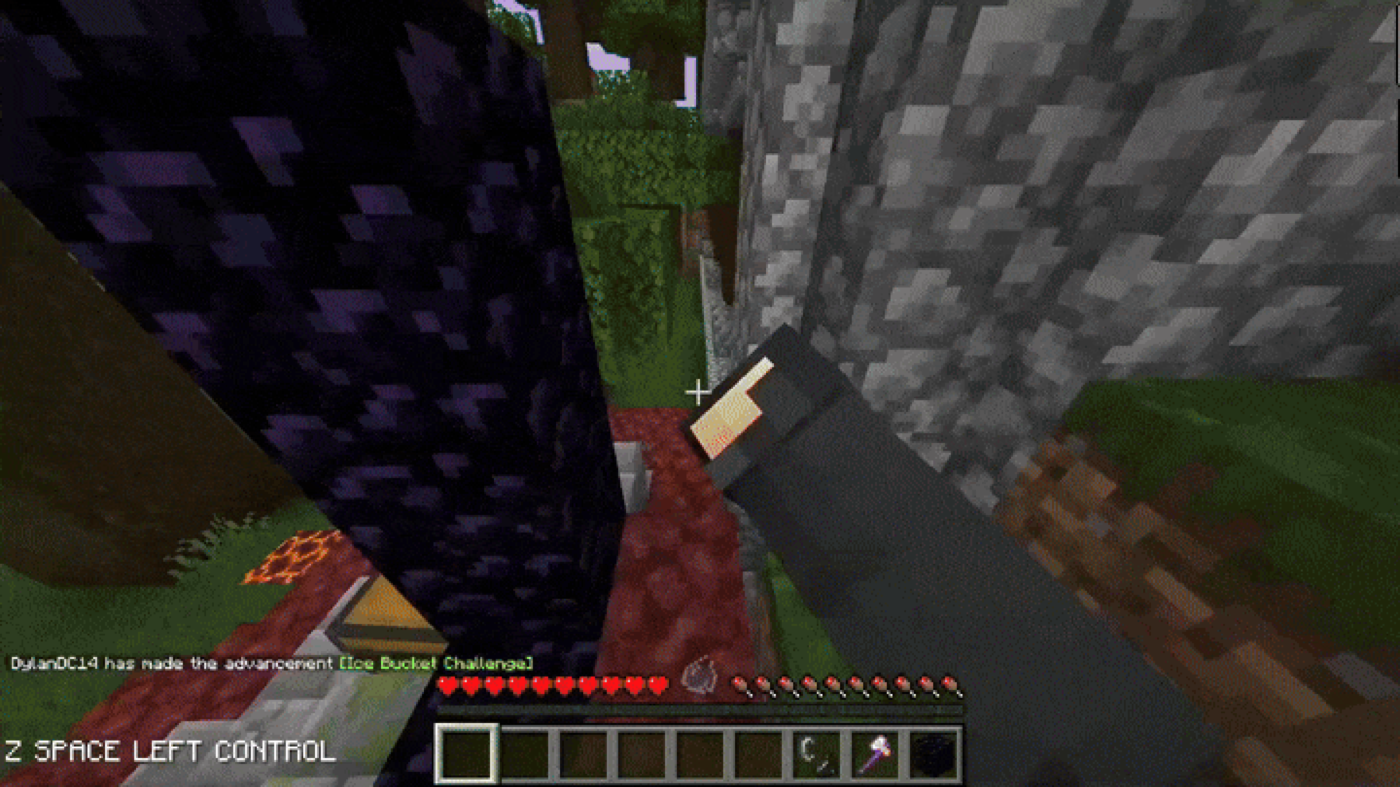
As a visualization of how *wild *this could be, look at some Youtube videos of video game speedruns, such as this one of beating Minecraft in 20 seconds.
Beating Minecraft in 20 seconds. (If you have no idea what’s going on in this video, you’re in good company; even most normal players of Minecraft have almost no clue what’s going on.)
Now imagine this applied to all domains of science, technology, and the economy. The error bars here, of course, are extremely large. Still, it’s important to consider just how consequential this would be.
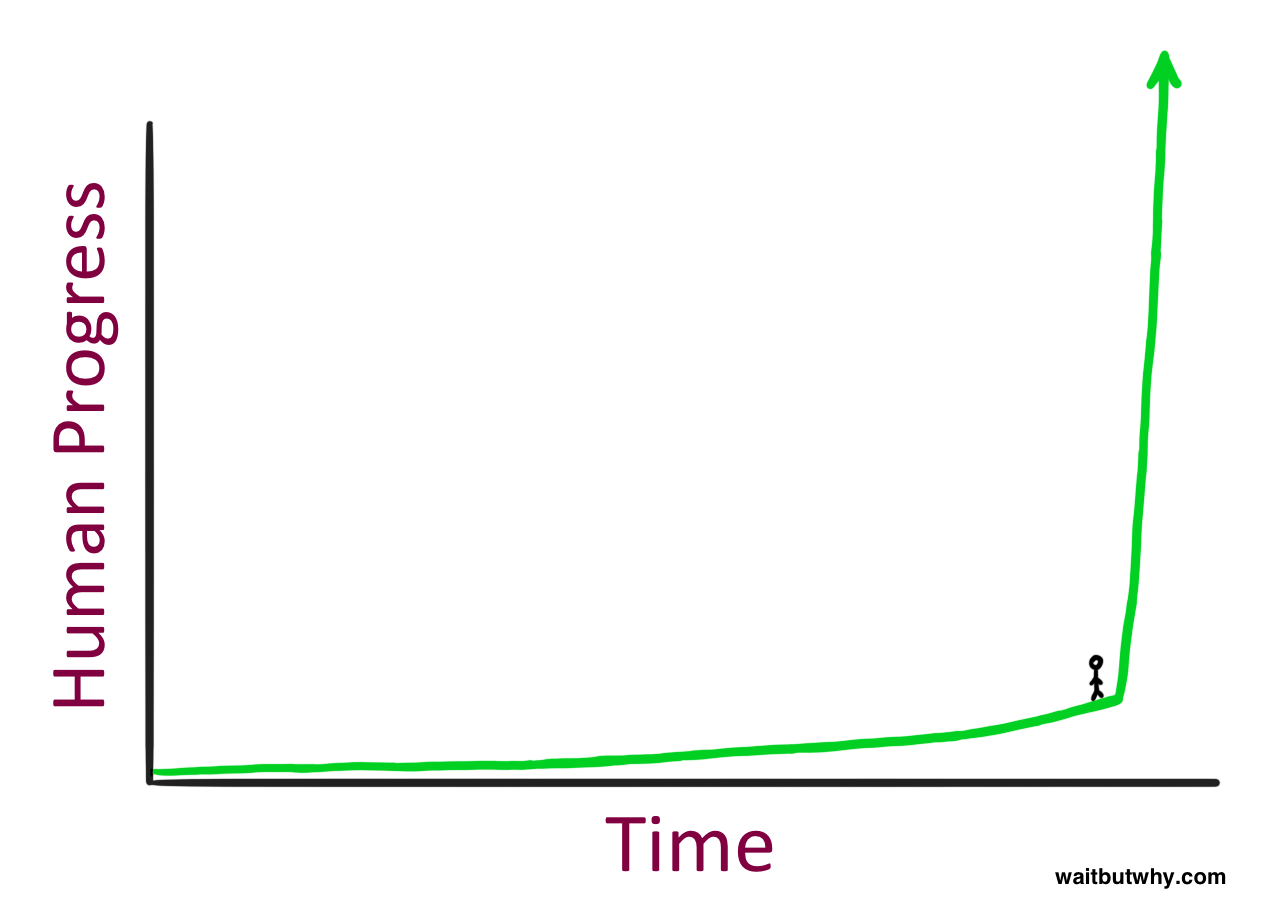
What does it feel like to stand here? Illustration from Wait But Why/Tim Urban.
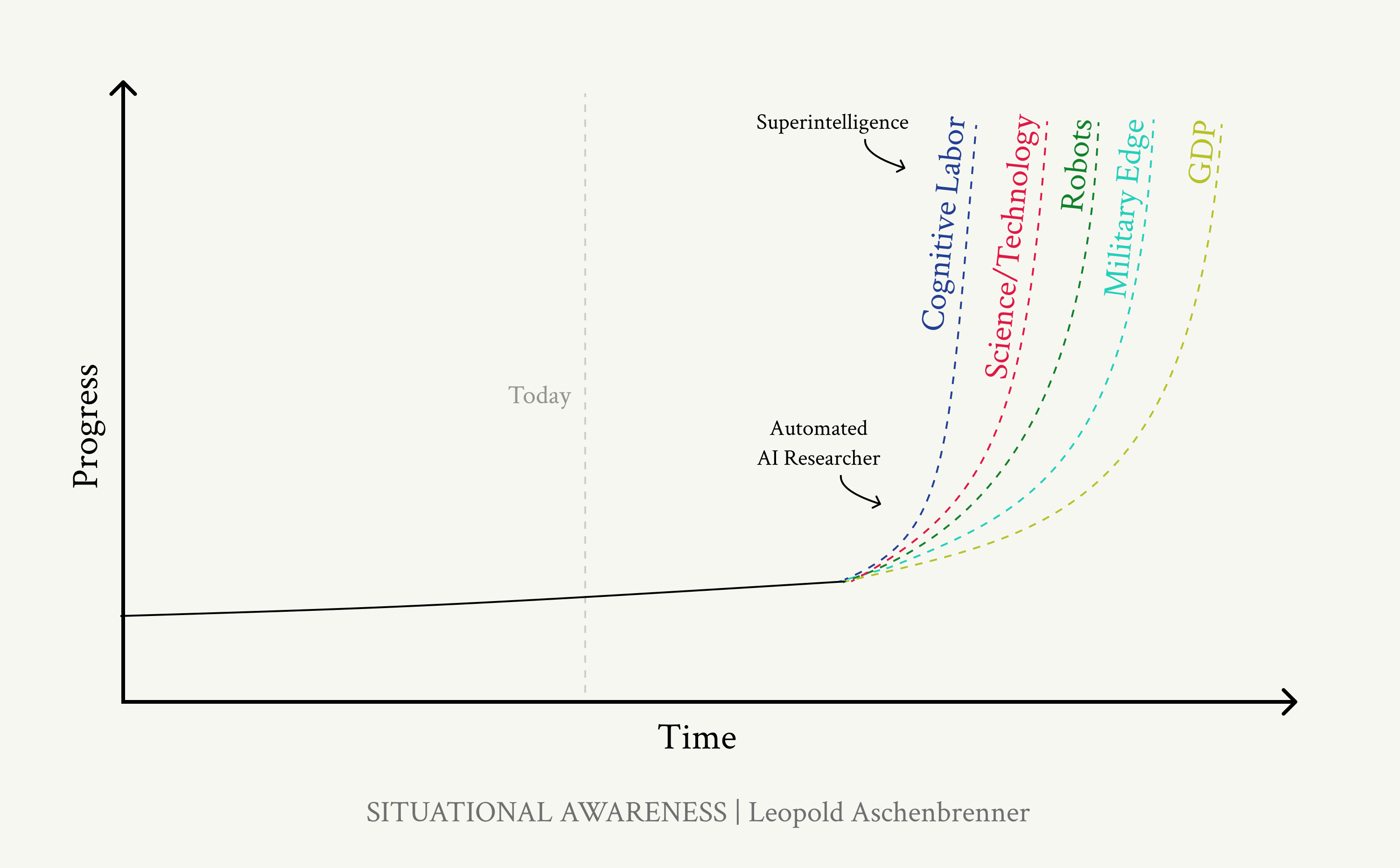
In the intelligence explosion, explosive progress was initially only in the narrow domain of automated AI research. As we get superintelligence, and apply our billions of (now superintelligent) agents to R&D across many fields, I expect explosive progress to broaden:
- *An AI capabilities explosion. *Perhaps our initial AGIs had limitations that prevented them fully automating work in some other domains (rather than just in the AI research domain); automated AI research will quickly solve these, enabling automation of any and all cognitive work.
- *Solve robotics. *Superintelligence won’t stay purely cognitive for long. Getting robotics to work well is primarily an ML algorithms problem (rather than a hardware problem), and our automated AI researchers will likely be able to solve it (more below). Factories would go from human-run, to AI-directed using human physical labor, to soon being fully run by swarms of robots.
- Dramatically accelerate scientific and technological progress. Yes, Einstein alone couldn’t develop neuroscience and build a semiconductor industry, but a billion superintelligent automated scientists, engineers, technologists, and robot technicians (with the robots moving at 10x or more human speed!)11 would make extraordinary advances in many fields in the space of years. (Here’s a nice short story visualizing what AI-driven R&D might look like.) The billion superintelligences would be able to compress the R&D effort humans researchers would have done in the next century into years. Imagine if the technological progress of the 20th century were compressed into less than a decade. We would have gone from flying being thought a mirage, to airplanes, to a man on the moon and ICBMs in a matter of years. This is what I expect the 2030s to look like across science and technology.
- *An industrial and economic explosion. *Extremely accelerated technological progress, combined with the ability to automate all human labor, could dramatically accelerate economic growth (think: self-replicating robot factories quickly covering all of the Nevada desert).12 The increase in growth probably wouldn’t just be from 2%/year to 2.5%/year; rather, this would be a fundamental shift in the growth regime, more comparable to the historical step-change from very slow growth to a couple percent a year with the industrial revolution. We could see economic growth rates of 30%/year and beyond, quite possibly multiple doublings a year. This follows fairly straightforwardly from economists’ models of economic growth. To be sure, this may well be delayed by societal frictions; arcane regulation might ensure lawyers and doctors still need to be human, even if AI systems were much better at those jobs; surely sand will be thrown into the gears of rapidly expanding robo-factories as society resists the pace of change; and perhaps we’ll want to retain human nannies; all of which would slow the growth of the overall GDP statistics. Still, in whatever domains we remove human-created barriers (e.g., competition might force us to do so for military production), we’d see an industrial explosion.
A shift in the growth regime is not unprecedented: as civilization went from hunting, to farming, to the blossoming of science and commerce, to industry, the pace of global economic growth accelerated. Superintelligence could kick off another shift in growth mode. Based on Robin Hanson’s "Long-run growth as a sequence of exponential modes*".*
- *Provide a decisive and overwhelming military advantage. *Even early cognitive superintelligence might be enough here; perhaps some superhuman hacking scheme can deactivate adversary militaries. In any case, military power and technological progress has been tightly linked historically, and with extraordinarily rapid technological progress will come concomitant military revolutions. The drone swarms and roboarmies will be a big deal, but they are just the beginning; we should expect completely new kinds of weapons, from novel WMDs to invulnerable laser-based missile defense to things we can’t yet fathom. Compared to pre-superintelligence arsenals, it’ll be like 21st century militaries fighting a 19th century brigade of horses and bayonets. (I discuss how superintelligence could lead to a decisive military advantage in a later piece.)
- *Be able to overthrow the US government. *Whoever controls superintelligence will quite possibly have enough power to seize control from pre-superintelligence forces. Even without robots, the small civilization of superintelligences would be able to hack any undefended military, election, television, etc. system, cunningly persuade generals and electorates, economically outcompete nation-states, design new synthetic bioweapons and then pay a human in bitcoin to synthesize it, and so on. In the early 1500s, Cortes and about 500 Spaniards conquered the Aztec empire of several million; Pizarro and ~300 Spaniards conquered the Inca empire of several million; Alfonso and ~1000 Portuguese conquered the Indian Ocean. They didn’t have god-like power, but the Old World’s technological edge and an advantage in strategic and diplomatic cunning led to an utterly decisive advantage. Superintelligence might look similar.
** Robots
A common objection to claims like those here is that, even if AI can do cognitive tasks, robotics is lagging way behind and so will be a brake on any real-world impacts.
I used to be sympathetic to this, but I’ve become convinced robots will not be a barrier. For years people claimed robots were a hardware problem—but robot hardware is well on its way to being solved.
Increasingly, it’s clear that robots are an *ML algorithms *problem. LLMs had a much easier way to bootstrap: you had an entire internet to pretrain on. There’s no similarly large dataset for robot actions, and so it requires more nifty approaches (e.g. using multimodal models as a base, then using synthetic data/simulation/clever RL) to train them.
There’s a ton of energy directed at solving this now. But even if we don’t solve it before AGI, our hundreds of millions of AGIs/superintelligences will make amazing AI researchers (as is the central argument of this piece!), and it seems very likely that they’ll figure out the ML to make amazing robots work.
As such, while it’s plausible that robots might cause a few years of delay (solving the ML problems, testing in the physical world in a way that is fundamentally slower than testing in simulation, ramping up initial robot production before the robots can build factories themselves, etc.)—I don’t think it’ll be more than that.
Explosive growth starts in the narrower domain of AI R&D; as we apply superintelligence to R&D in other fields, explosive growth will broaden.
How all of this plays out over the 2030s is hard to predict (and a story for another time). But one thing, at least, is clear: we will be rapidly plunged into the most extreme situation humanity has ever faced.
Human-level AI systems, AGI, would be highly consequential in their own right—but in some sense, they would simply be a more efficient version of what we already know. But, very plausibly, within just a year, we would transition to much more alien systems, systems whose understanding and abilities—whose raw power—would exceed even those of humanity combined. There is a real possibility that we will lose control, as we are forced to hand off trust to AI systems during this rapid transition.
More generally, everything will just start happening incredibly fast. And the world will start going insane. Suppose we had gone through the geopolitical fever-pitches and man-made perils of the 20th century in mere years; that is the sort of situation we should expect post-superintelligence. By the end of it, superintelligent AI systems will be running our military and economy. During all of this insanity, we’d have extremely scarce time to make the right decisions. The challenges will be immense. It will take everything we’ve got to make it through in one piece.
***The intelligence explosion and the immediate post-superintelligence period will be one of the most volatile, tense, dangerous, and wildest periods ever in human history. ***
And by the end of the decade, we’ll likely be in the midst of it.
Confronting the possibility of an intelligence explosion—the emergence of superintelligence—often echoes the early debates around the possibility of a nuclear chain reaction—and the atomic bomb it would enable. HG Wells predicted the atomic bomb in a 1914 novel. When Szilard first conceived of the idea of a chain reaction in 1933, he couldn’t convince anyone of it; it was pure theory. Once fission was empirically discovered in 1938, Szilard freaked out again and argued strongly for secrecy, and a few people started to wake up to the possibility of a bomb. Einstein hadn’t considered the possibility of a chain reaction, but when Szilard confronted him, he was quick to see the implications and willing to do anything that was needed to be done; he was willing to sound the alarm, and wasn’t afraid of sounding foolish. But Fermi, Bohr, and most scientists thought the "conservative" thing was to play it down, rather than take seriously the extraordinary implications of the possibility of a bomb. Secrecy (to avoid sharing their advances with the Germans) and other all-out efforts seemed absurd to them. A chain reaction sounded too crazy. (Even when, as it turned out, a bomb was but half a decade from becoming reality.)
We must once again confront the possibility of a chain reaction. Perhaps it sounds speculative to you. But among senior scientists at AI labs, many see a rapid intelligence explosion as strikingly plausible. They can see it. Superintelligence is possible.
Next post in series: ***III. The Challenges – IIIa. Racing to the Trillion-Dollar Cluster***
And much of the Cold War’s perversities (cf Daniel Ellsberg’s book) stemmed from merely replacing A-bombs with H-bombs, without adjusting nuclear policy and war plans to the massive capability increase.↩
The job of an AI researcher is also a job that AI researchers at AI labs just, well, know really well—so it’ll be particularly intuitive to them to optimize models to be good at that job. And there will be huge incentives to do so to help them accelerate their research and their labs’ competitive edge.↩
This suggests an important point in terms of the sequencing of risks from AI, by the way. A common AI threat model people point to is AI systems developing novel bioweapons, and that posing catastrophic risk. But if AI research is more straightforward to automate than biology R&D, we might get an intelligence explosion before we get extreme AI biothreats. This matters, for example, with regard to whether we should expect "bio warning shots" in time before things get crazy on AI.↩
As noted earlier, the GPT-4 API costs less today than GPT-3 when it was released—this suggests that the trend of inference efficiency wins is fast enough to keep inference costs roughly constant even as models get much more powerful. Similarly, there have been huge inference cost wins in just the year since GPT-4 was released; for example, the current version of Gemini 1.5 Pro outperforms the original GPT-4, while being roughly 10x cheaper.
We can also ground this somewhat more by considering Chinchilla scaling laws. On Chinchilla scaling laws, model size—and thus inference costs—grow with the square root of training cost, i.e. half the OOMs of the OOM scaleup of effective compute. However, in the previous piece, I suggested that algorithmic efficiency was advancing at roughly the same pace as compute scaleup, i.e. it made up roughly half of the OOMs of effective compute scaleup. If these algorithmic wins also translate into inference efficiency, that means that the algorithmic efficiencies would compensate for the naive increase in inference cost.
In practice, training compute efficiencies often, but not always, translate into inference efficiency wins. However, there are also separately many inference efficiency wins that are not training efficiency wins. So, at least in terms of the rough ballpark, assuming the $/token of frontier models stays roughly similar doesn’t seem crazy.
(Of course, they’ll use more tokens, i.e. more test-time compute. But that’s already part of the calculation here, by pricing human-equivalents as 100 tokens/minute.)↩
GPT-4 Turbo is about $0.03/1K tokens. We supposed we would have 10s of millions of A100 equivalents, which cost ~$1 hour per GPU if A100-equivalents. If we used the API costs to translate GPUs into tokens generated, that implies 10s of millions GPUs * $1/GPU-hour * 33K tokens/$ = ~ one trillion tokens/ hour. Suppose a human does 100 tokens/min of thinking, that means a human-equivalent is 6,000 tokens/hour. One trillion tokens/hour divided by 6,000 tokens/human-hour = ~200 million human-equivalents—i.e. as if running 200 million human researchers, day and night. (And even if we reserve half the GPUs for experiment compute, we get 100 million human-researcher-equivalents.)↩
The previous footnote estimated ~1T tokens/hour, i.e. 24T tokens a day. In the previous piece, I noted that a public deduplicated CommonCrawl had around 30T tokens.↩
Jacob Steinhardt estimates that k^3 parallel copies of a model can be replaced with a single model that is k^2 faster, given some math on inference tradeoffs with a tiling scheme (that theoretically works even for k of 100 or more). Suppose initial speeds were already ~5x human speed (based on, say, GPT-4 speed on release). Then, by taking this inference penalty (with k= ~5), we’d be able to run ~1 million automated AI researchers at ~100x human speed.↩
This source benchmarks throughput of Flash at ~6x GPT-4 Turbo, and GPT-4 Turbo was faster than original GPT-4. Latency is probably also roughly 10x faster.↩
Alec Radford is an incredibly gifted and prolific researcher/engineer at OpenAI, behind many of the most important advances, though he flies under the radar some.↩
25 OOMs of algorithmic progress on top of GPT-4, for example, are clearly impossible: that would imply it would be possible to train a GPT-4-level model with just a handful of FLOP.↩
The 10x speed robots doing physical R&D in the real world is the "slow version"; in reality the superintelligences will try to do as much R&D as possible in simulation, like AlphaFold or manufacturing "digital twins".↩
Why isn’t "factorio-world"—build a factory, that produces more factories, producing even more factories, doubling factories until eventually your entire planet is quickly covered in factories—possible today? Well, labor is constrained—you can accumulate capital (factories, tools, etc.), but that runs into diminishing returns because it’s constrained by a fixed labor force. With robots and AI systems being able to fully automate labor, that removes that constraint; robo-factories could produce more robo-factories in an ~unconstrained way, leading to an industrial explosion. See more economic growth models of this here.↩
AI 的进步不会止步于人类水平。数以亿计的 AGI(hundreds of millions)可以自动化 AI 研究,把十年(5+ OOMs,数量级)的算法进步压缩到 ≤1 年之内。我们将迅速从人类水平的 AI 系统走向远超人类的超级智能系统。超级智能的力量——以及危险——将是戏剧性的。
本文包含: 切换
将超智能机器(ultraintelligent machine)定义为一台能够在所有智力活动中远远超越任何(无论多么聪明的)人的机器。由于机器设计正是这些智力活动之一,一台超智能机器便能设计出更好的机器;届时将毫无疑问地发生一场"智能爆炸",人类的智能将被远远抛在身后。因此,第一台超智能机器将是人类最后需要做出的发明。
炸弹与超级炸弹
在一般人的想象中,冷战的恐怖主要追溯到洛斯阿拉莫斯(Los Alamos)与原子弹的发明。但单看"炸弹"本身,也许被高估了。从"炸弹"到"超级炸弹"——氢弹——的这一步,可以说同样重要。
在东京空袭中,数百架轰炸机向这座城市投下了数千吨常规炸弹。同年晚些时候,投向广岛的"小男孩"(Little Boy)以单件武器释放出相近的破坏力。但仅仅 7 年后,泰勒(Teller)的氢弹又将当量提升了整整一千倍——一枚炸弹的爆炸威力超过二战中所有投下的炸弹的总和。
"炸弹"是一次更高效的轰炸行动。"超级炸弹"则是能毁灭一个国家的装置。1
AGI 与超级智能(Superintelligence)的关系也是如此。
*AI 的进步不会止步于人类水平。*AlphaGo 在最初学习了人类最优棋局之后,开始与自己下棋——它很快便超越了人类水平,走出了人类永远不会想到的极富创造性与复杂度的棋着。
我们在上一篇中讨论了通往 AGI 的路径。一旦我们获得 AGI,我们会再摇动一次曲柄——或者两三次——AI 系统将变得超人类——远超人类。它们在质的层面将比你我都聪明,聪明得多,也许就像你我在质的层面比一个小学生更聪明一样。
在目前快速但连续的 AI 进步速度下,跃向超级智能本身已经够疯狂了(如果我们能花 4 年从 GPT-4 跃升到 AGI,再往后 4 年或 8 年会带来什么?)。但如果 AGI 将 AI 研究本身自动化,这个进程可能比这快得多。
一旦我们获得 AGI,我们不会只有一个 AGI。稍后我会详细过一遍数字,但大致是:考虑到届时可用的推理 GPU 集群,我们很可能可以运行数以百万计的副本(或许相当于 100 million 个人类等价体,并且很快将以 10x 以上的人类速度运行)。即使它们还不能在办公室走动或泡咖啡,它们也能够在计算机上做 ML 研究。我们得到的将不是一家顶尖 AI 实验室里的几百名研究人员和工程师,而是其 100,000x 以上——日夜不停地攻关算法突破。是的,递归式自我改进,但无需科幻设定;它们只需要加速既有的算法进步趋势线(目前约为每年 0.5 OOMs)。
自动化的 AI 研究可能加速算法进步,在一年内带来 5+ OOMs 的有效算力收益。到一场智能爆炸结束时我们将拥有的 AI 系统,会比人类聪明得多。
自动化的 AI 研究很可能把人类十年的算法进步压缩到不到一年(这看起来还算保守)。那将是 5+ OOMs,是又一次从 GPT-2 到 GPT-4 规模的跃升,并且叠加在 AGI 之上——一次像从学龄前儿童到聪明高中生的质的跃升,叠加在已经像资深 AI 研究员/工程师一样聪明的 AI 系统之上。
有几个看似合理的瓶颈——包括实验算力有限、与人类的互补性,以及算法进步变得更加困难——我会逐一讨论,但似乎没有哪一个足以真正拖慢进程。
转眼之间,我们手中就会握有超级智能——远超人类聪明的 AI 系统,能够表现出我们根本无法理解的崭新、创造性的复杂行为——甚至可能是由数十亿个这样的系统组成的小型文明。它们的力量也将是巨大的。将超级智能应用于其它领域的研发,爆炸式进步将从单纯的 ML 研究扩散开来;很快它们会攻克机器人技术,在数年内让科学技术其它领域取得戏剧性飞跃,随后工业爆炸接踵而至。超级智能很可能提供决定性的军事优势,并释放难以估量的毁灭力量。我们将面对人类历史上最激烈、最动荡的时刻之一。
自动化 AI 研究
**我们不需要自动化一切——只需要自动化 AI 研究。**对 AGI 变革性影响的一个常见反驳是:AI 将很难做好所有事情。质疑者说,比如看机器人技术,即使 AI 的认知水平达到博士级别,那也将是一个棘手问题。再比如自动化生物学研发,那可能需要大量实体实验室工作和人类实验。
但我们不需要机器人技术——我们不需要很多东西——AI 就能自动化 AI 研究。顶尖实验室里 AI 研究员和工程师的工作可以完全在虚拟环境中完成,不会以同样的方式撞上现实世界的瓶颈(不过它仍将受算力限制,这一点我稍后会讨论)。而从全局来看,AI 研究员的工作相当直截了当:阅读 ML 文献并提出新问题或新想法,实施实验检验这些想法,解读结果,然后重复。这一切看起来完全处于这样一个领域:仅凭对当前 AI 能力的简单外推,就能轻而易举地让我们在2027 年底之前达到或超越最优秀人类的水平。2
值得强调的是,过去十年一些最大的机器学习突破是多么直白而取巧:"哦,只要加一点归一化"(LayerNorm/BatchNorm),或者"把 f(x) 改成 f(x)+x"(残差连接),或者"修一个实现上的 bug"(Kaplan → Chinchilla 缩放定律)。AI 研究是可以自动化的。而自动化 AI 研究正是启动非凡反馈循环所需的一切。3
**我们将能运行数以百万计的自动化 AI 研究员副本(并且很快能以 10x 以上的人类速度运行)。**即使到 2027 年,我们也应预期拥有数以千万计的 GPU 集群。仅训练集群的规模就可能比现在大约高出 3 OOMs,已经把我们带到 10 million+ 个 A100 等效(A100-equivalent)。推理集群规模还要大得多。(更多细节见后续文章。)
这让我们得以运行数以百万计的自动化 AI 研究员副本,也许相当于 100 million 个人类研究员等价体,日夜不停地运转。精确数字背后有一些假设,包括人类以 100 tokens/分钟 的速度"思考"(这只是一个粗略的数量级估计,比如想想你的内心独白),以及假设前沿模型每 token 推理成本的历史趋势和 Chinchilla 缩放定律外推仍大致处于同一量级。4 我们还需要留出一部分 GPU 用于运行实验和训练新模型。完整计算见脚注。5
另一种思考方式是:以 2027 年的推理集群,我们应该每天都能生成相当于整个互联网体量的 tokens。6 无论如何,除了做一个简单的可行性演示之外,精确数字并不那么重要。
此外,我们的自动化 AI 研究员也许很快就能以远高于人类的速度运行:
- 通过承担一些推理代价,我们可以用更少的副本数换取更快的串行速度。(例如,我们"只需"运行 1 million 个自动化研究员副本,就能从约 5x 的人类速度提升到约 100x 的人类速度。7)
- 更重要的是,自动化 AI 研究员要做的第一项算法创新就是获得 10x 或 100x 的加速。Gemini 1.5 Flash 比最初发布的 GPT-4 快约 10x,8 而这仅仅晚了一年,且在推理基准上的表现与最初发布的 GPT-4 相当。如果这就是几百名人类研究员一年内能取得的算法加速,那么自动化 AI 研究员将很快取得类似的成果。
*也就是说:在我们能够自动化 AI 研究之后不久,可以预期 100 million 个自动化研究员,每个都以 100x 的人类速度工作。*它们每一个都能在几天内完成一年的工作量。与今天一家顶尖 AI 实验室里那几百名以可怜的 1x 人类速度工作的渺小人类研究员相比,研究力量的增长将是惊人的。
**这很容易急剧加速既有的算法进步趋势,把十年的进展压缩进一年。**我们不需要假设任何全新的事物,自动化 AI 研究就能大力加速 AI 进步。在上一篇中过一遍数字时,我们看到算法进步是过去十年深度学习进步的核心驱动力;我们注意到仅算法效率一项的趋势线就约为每年 0.5 OOMs,此外"解除束缚"(unhobbling)还带来大量额外算法收益。(我认为许多人低估了算法进步的重要性,而恰当地认识到这一点,对于理解智能爆炸的可能性至关重要。)
我们数以百万计的自动化 AI 研究员(很快将以 10x 或 100x 的人类速度工作)能把人类研究员十年才会取得的算法进步压缩到一年吗?那将是一年 5+ OOMs。
请不要只把这里的场景想象成 100 million 名初级软件工程师实习生(再过两三年我们就会有那样的场景!)。真正的自动化 AI 研究员将非常聪明——除了纯粹的量化优势之外,自动化 AI 研究员相对人类研究员还有其它巨大优势:
- 它们能读遍所有已发表的 ML 论文,能深入思考实验室里运行过的每一个既往实验,能从各自的副本那里并行学习,并迅速积累相当于数千年经验的知识。它们对 ML 将能建立起比任何人类都深刻得多的直觉。
- 它们能轻松写出数百万行复杂代码,把整个代码库保持在上下文里,并花费相当于人类数十年的时间(或更长)反复检查每一行代码的 bug 与优化空间。它们将出色地胜任这份工作的所有环节。
- 你不必逐一培训每一位自动化 AI 研究员(确实,培训和入职 100 million 名新的人类雇员会很难)。相反,你只需教会并让其中一个上岗——然后复制它。(而且你不用担心办公室政治、文化适应等等,它们会以巅峰的精力和专注日夜工作。)
- 海量的自动化 AI 研究员将能共享上下文(也许甚至能访问彼此的潜在空间等等),这使得协作与协调比人类研究员高效得多。
- 而且当然,无论我们最初的自动化 AI 研究员有多聪明,我们很快就能做出进一步的 OOM 级跃升,造出更聪明的模型,在自动化 AI 研究上更有能力。
想象一个自动化的 Alec Radford——想象 100 million 个自动化的 Alec Radford。9 我觉得 OpenAI 几乎每位研究员都会同意:如果他们拥有 10 个 Alec Radford,更不用说 100 个、1,000 个或 1 million 个以 10x 或 100x 人类速度运行的 Alec Radford,他们就能很快解决非常多的问题。即使存在各种其它瓶颈(稍后详述),由此把十年的算法进步压缩到一年似乎也完全合理。(一百万倍的研究力量带来 10x 加速——这怎么看都只嫌保守。)
单此一项就是 5+ OOMs。5 OOMs 的算法收益,其规模与催生从 GPT-2 到 GPT-4 的跃升相当,那是从约学龄前儿童到约聪明高中生的能力跃升。想象这种质的跃升叠加在AGI 之上,叠加在Alec Radford 之上。
我们极有可能在非常短的时间内——也许不到一年——就从 AGI 走到超级智能。
可能的瓶颈
虽然这个基本故事出人意料地有力——并且有透彻的经济建模研究作为支撑——但确实存在一些真实而合理的瓶颈,可能会拖慢由自动化 AI 研究驱动的智能爆炸。
我在这里先给出一个概述,然后在下面几个可选章节中为感兴趣的读者做更详细的讨论:
- 算力有限:AI 研究不仅需要好点子、思考或数学——还需要运行实验来为你的想法获取经验信号。通过自动化研究劳动力获得的一百万倍研究力量,并不意味着一百万倍的进度提升,因为算力仍然是有限的——而实验算力受限将成为瓶颈。尽管如此,即使这不会带来 1,000,000x 的加速,我也很难想象自动化 AI 研究员不能至少把算力利用得高效 10x:它们将获得不可思议的 ML 直觉(把全部 ML 文献和运行过的每一个既往实验都内化于心!),并拥有相当于几个世纪的思考时间,来精确确定该运行哪个实验、如何最优地配置它、以及如何获取最大的信息价值;它们可以在运行哪怕极小的实验之前,花费相当于几个世纪的工程师时间来避免 bug、一次成功;它们可以做出权衡,通过聚焦于最大的收益来节省算力;它们还将能尝试大量更小规模的实验(考虑到届时有效算力的规模化提升,"更小规模"意味着一年内能训练 100,000 个 GPT-4 级别的模型来试验架构突破)。有些人类研究员和工程师即使拥有同样的算力,也能产出别人 10x 的进展——这一点应该更加适用于自动化 AI 研究员。我确实认为这是最重要的瓶颈,下面我会更深入地讨论它。
- 互补性/长尾:经济学的一个经典教训(参见 Baumol 的增长病)是:如果你能自动化某事的 70%,你会获得一些收益,但剩下的 30% 很快就会成为你的瓶颈。对于任何达不到完全自动化的情形——比如说,非常好的副驾驶(copilot)——人类 AI 研究员仍将是主要瓶颈,使算法进步速度的整体提升相对较小。此外,自动化 AI 研究所需的能力很可能存在某种长尾——AI 研究员工作中最后的 10% 可能特别难以自动化。这可能会在一定程度上削弱起飞的速度,不过我的最佳猜测是,这只会把事情推迟几年。也许 2026/27 年级别的模型速度就是原初自动化研究员(proto-automated-researcher),还需要一两年来完成最后的"解除束缚"、推出更好的模型、获得推理加速并解决各种细节问题,才能达到完全自动化,最终到 2028 年我们得到 10x 加速(并在本十年末获得超级智能)。
- 算法进步的固有极限:也许再取得 5 OOMs 的算法效率在根本上是不可行的?我对此表示怀疑。虽然肯定存在上限,10 但如果我们过去十年拿到了 5 OOMs,那么我们大概应该预期至少还有一个十年量级的进步是可能的。更直接地说,当前的架构和训练算法仍然非常初级,而且看起来应该可能存在高效得多的方案。生物学参照类(reference classes)也支持"存在戏剧性高效得多的算法"这一论断是合理的。
- 想法越来越难找,所以自动化 AI 研究员只会维持、而非加速当前的进步速度:一种反驳意见是:尽管自动化研究会大大增加有效研究力量,但想法也会越来越难找。也就是说,虽然今天一家实验室只需要几百名顶尖研究员就能维持每年 0.5 OOMs,但随着我们摘光低垂的果实,维持这种进步将需要越来越多的努力——因此那 100 million 个自动化研究员不过是维持进步所需的最低限度。我认为这个基本模型是正确的,但经验数据对不上:研究力量的增长幅度——一百万倍——比历史上维持进步所需研究力量的增长趋势要大得多得多。用经济学建模的话说,假设自动化带来的研究力量增长会恰好足以让进步保持恒定,是一种古怪的"刀锋假设"(knife-edge assumption)。
- 想法越来越难找且存在收益递减,所以智能爆炸很快就会熄火:与上述反驳相关:即使自动化 AI 研究员带来了最初的进步爆发,快速进步能否持续,取决于算法进步收益递减曲线的形状。同样,我对经验证据的最佳解读是:各种指数关系倾向于支持爆炸式/加速式进步。无论如何,一次性助推的规模之大——从几百名增加到数以亿计的 AI 研究员——大概至少能在相当多个 OOM 的算法进步上克服收益递减,尽管它当然不可能无限期自我维持。
实验算力有限
算法进步的生产函数包含两个互补的生产要素:研究力量与实验算力。数以百万计的自动化 AI 研究员在运行实验时,并不会比人类 AI 研究员拥有更多算力;也许它们只能干坐在那里等任务跑完。
这很可能是智能爆炸最重要的瓶颈。归根结底这是一个定量问题——它究竟在多大程度上构成瓶颈?总体而言,我很难相信那 100 million 个 Alec Radford 无法把实验算力的边际产出提高至少 10x(因此仍然会让进步速度加快 10x):
- *较少的算力也能做很多事。*大多数 AI 研究的工作方式是:先在小规模上做测试——然后通过缩放定律外推。(许多关键的历史性突破只需要极少的算力,例如最初的 Transformer 只用了 8 块 GPU 训练了几天。)而且请注意,在未来四年中约 5 OOMs 的基线规模提升之下,"小规模"将意味着 GPT-4 级别——自动化 AI 研究员一年内在它们的训练集群上能运行 100,000 个 GPT-4 级别的实验,以及数千万个 GPT-3 级别的实验。(它们能测试大量可能带来突破的新架构!)
- 大量算力用于对最终预训练运行进行更大规模的验证——确保你为年度主打产品在边际效率收益上获得足够高的置信度——但如果你正以智能爆炸的速度冲刺 OOMs,你可以精打细算,只专注于真正的大收益。
- 正如上一篇所讨论的,"解除束缚"模型(unhobbling)往往能以相对较低的算力带来巨大收益。这些不需要大型预训练。智能爆炸很可能就从自动化的 AI 研究起步,例如发现一种在模型之上做 RL 的方法,通过解除束缚的收益带给我们几个 OOMs(然后我们就一骑绝尘了)。
- *随着自动化 AI 研究员找到各种效率提升,它们将能运行更多实验。*回想上一篇讨论过的:仅凭人类水平的算法进步,两年内同等 MATH 性能下的推理成本就便宜了近 1000x,过去一年里通用推理收益也有 10x。自动化 AI 研究员要做的第一件事就是迅速找到类似的收益,进而让它们能在例如新的 RL 方法上多运行 100x 数量的实验。或者它们将能快速做出在相关领域性能相近的更小模型(参见之前关于 Gemini Flash 的讨论,其成本比 GPT-4 便宜近 100x),这反过来又让它们能用这些更小的模型运行多得多的实验(同样,想象用它们来尝试不同的 RL 方案)。可能还存在其它"悬垂收益"(overhangs),例如自动化 AI 研究员可能很快开发出好得多的分布式训练方案,以利用所有的推理 GPU(单此一项大概就有至少 10x 的算力)。更一般地说,它们每找到 1 OOM 的训练效率收益,就会多出 1 OOM 的有效算力来运行实验。
- *自动化 AI 研究员可以高效得多。*如果一次就能做对——没有棘手的 bug、对到底跑什么更加挑剔等等——你能少跑多少实验,这一点怎么强调都不过分。想象 1000 个自动化 AI 研究员花相当于一个月的时间检查你的代码,在你按下运行键之前把实验精确调对。我就此问过一些 AI 实验室的同事,他们表示同意:只要你能避免无聊的 bug、一次就把事情做对、只运行信息价值高的实验,在大多数项目上你应该就能相当轻松地省下 3x-10x 的算力。
- 自动化 AI 研究员可以拥有好得多的直觉。
- 最近,我和一家前沿实验室的实习生聊天;他说过去几个月的主要体验是:他提出许多想运行的实验,而他的导师(一位资深研究员)说他们事先就能预测结果,所以没必要跑。那位资深研究员多年随意摆弄模型做各种实验,磨砺出了对哪些想法会有效(或无效)的直觉。类似地,看起来我们的 AI 系统很容易就能获得关于 ML 实验的超人直觉——它们将读遍整个机器学习文献,能从其它每一个实验结果中学习并深入思考,它们可以轻松地被训练去预测数百万个 ML 实验的结果,等等。也许它们最先做的事情之一,就是建立一门扎实的基础科学,用来"在看到训练的前 1% 之后、或看到该实验的更小规模版本之后,预测这个大规模实验是否会成功",诸如此类。
- 此外,除了对研究方向拥有极好的直觉之外,正如 Jason Wei 所指出的,对一个实验的几十个超参数和细节拥有出色直觉会带来不可思议的回报。Jason 把这种基于直觉、一次就做对的能力称为"yolo runs"。(Jason 说:"我所确知的是,能做到这一点的人肯定是 10-100x 的 AI 研究员。")
算力瓶颈意味着,一百万个倍多的研究员不会转化为一百万倍快的研究——因此不会出现一夜之间的智能爆炸。但自动化 AI 研究员相对人类研究员拥有非凡的优势,因此很难想象它们找不到办法把算力利用得至少高效/有效 10x——所以算法进步速度提升 10x 似乎完全合理。
更多讨论见下方嵌套的折叠栏中。
回应最有力的反驳:ML 学界的既有表现对算力瓶颈意味着什么?
这里我想花点时间承认我听到过的最有说服力的一种反驳表述,它来自我的朋友 James Bradbury:如果更多的 ML 研究力量能如此戏剧性地加速进步,为什么当下人数至少数以万计的学术 ML 研究群体,对前沿实验室进步的贡献却不多?(目前看来,似乎是实验室内部团队——各实验室合计也许一千人——承担了前沿算法进步的大部分工作。)他的论点是:原因是算法进步受算力瓶颈制约——学术界就是没有足够的算力。
几点回应:
- 按质量调整后,我认为学术界人士大概在数千而非数万之数(例如只看顶尖大学)。这可能不会比各实验室合计多多少。(而且比我们从自动化 AI 研究得到的数以亿计的研究员要少得多。)
- 学术界研究的东西不对。直到不久之前(也许今天依然如此?),学术 ML 群体的绝大多数人甚至都不在研究大语言模型。
- 就算只算学术界研究大语言模型的强人,人数可能也明显少于各实验室研究员的合计?
- 即使学术界确实研究 LLM 预训练之类的东西,他们也根本无法接触最前沿——即实验室内部积累的大量关于前沿模型训练的细节知识。他们不知道哪些问题才是真正相关的,或者只能贡献一些一次性结果,而没人真正能用得上这些结果,因为他们的基线调得很差(所以没人知道他们的东西是否真的是改进)。
- 学术界人士比自动化 AI 研究员差得多:他们无法以 10x 或 100x 的人类速度工作,无法读遍并内化所有已发表的 ML 论文,无法花十年时间检查每一行代码,无法自我复制来避免入职瓶颈,等等。
与"学术界论"相反的另一个例子:据传 GDM 拥有比 OpenAI 多得多的实验算力,然而 GDM 似乎并没有在算法进步上大幅超越 OpenAI。
总的来说,我预期自动化研究员会采用一种发挥自身优势、力求缓解算力瓶颈的不同的研究风格。我认为对这种局面最终如何发展感到不确定是合理的,但如果仅仅因为人类很难绕过算力瓶颈,就确信模型也无法做到,那就不合理了。
- 例如,它们可以在早期投入大量精力建立一门"如何从小规模实验预测大规模结果"的基础科学。而且我预期它们能做很多人类做不到的事,例如类似"在看到训练的前 1% 之后预测这个大规模实验是否会成功"。如果你是一个拥有超强超人直觉的自动化研究员,这看起来相当可行,而且能省下大量算力。
- 当我设想 AI 系统自动化 AI 研究时,我看到它们受算力瓶颈制约,但在很大程度上通过比如比人类多思考 1000x(而且更快)、思考质量也比人类更高来弥补(例如,因为接受过预测数百万实验结果的训练而拥有超人的 ML 直觉)。除非它们在思考方面比工程方面糟糕得多,否则我认为这能弥补很多,而且这与学术界将是质的不同。
(除了实验算力之外,还有一个额外瓶颈,即最终需要运行一次大规模训练——目前这需要几个月。但你们大概可以在这方面精打细算,在智能爆炸的那一年里只做屈指可数的几次,而且每次比实验室当前所做的取得更大的 OOM 跃升。
请注意,虽然我认为这很可能发生,但它有点可怕:这意味着,与其说会有一系列相当连续的大模型、每一个都比上一代好一些,下游模型的智能可能更离散/不连续。在智能爆炸期间,我们可能只做一次或几次大规模运行,把在小规模下发现的多个 OOM 算法突破一次性押注进去。
或者你也可以"花掉"5 OOMs 算力效率收益中的 1 OOM,把一次训练从几个月缩短到几天。)
通往 100% 自动化的互补性与长尾
经济学家对"AI 自动化加速经济增长"的经典反驳是:不同任务是互补的——因此,例如,自动化 1800 年人类劳动所做工作的 80%,并没有带来增长爆炸或大规模失业,而是剩下的 20% 成为所有人类所从事的工作并始终是瓶颈。(例如,这里有一个这样的模型。)
我认为经济学家的模型在这里是正确的。但关键的一点是,我说的只是经济中目前很小的一部分,而不是整个经济。在那段时间里,人们很可能还会正常理发——机器人技术也许还没搞定,每个领域的 AI 也许还没搞定,社会层面的推广也许还没搞定,等等——但它们将能够做 AI 研究。正如上一篇所讨论的,我认为当前 AI 进步的路线正在把我们带向本质上即插即用的远程工作者,其聪明程度与最聪明的人类相当;正如本文所讨论的,AI 研究员的工作似乎完全在可以完全自动化的范围之内。
不过,在实践中,我确实预期即使对于 AI 研究员/工程师的工作,要达到真正的 100% 自动化也存在一定的长尾;例如,我们可能先得到一些几乎能替代工程师的系统,但仍需要一定程度的人类监督。
具体来说,我预期 AI 的能力水平在不同领域会有些参差、高低不一:它可能是比最优秀的工程师还好的程序员,同时在某些任务或技能的某个子集上仍有盲点;等它在自己最差的方面达到人类水平时,它在更易训练的领域(比如编程)已经大幅超越人类。(这就是我认为它们能比人类研究员更有效地利用算力的部分原因。到 100% 自动化/智能爆炸开始的时候,它们在有些领域已经对人类拥有巨大优势。这也会对之后的超级对齐产生重要影响,因为这意味着,为了对齐哪怕第一批自动化 AI 研究员,我们也将必须对齐在许多领域明显超越人类的系统。)
但我预计这个阶段不会持续超过几年;考虑到 AI 进步的速度,我认为很可能只需再做一些"解除束缚"(移除模型中妨碍它跑完最后一公里的明显局限),或者再推出一代新模型,就能走完全程。
总体而言,这可能会在一定程度上减缓起飞。与其说是 2027 年 AGI → 2028 年超级智能,它可能更像是:
- 2026/27:原初自动化工程师(proto-automated-engineer),但在其它领域有盲点。已经能把工作提速 1.5x-2x;进步开始逐步加速。
- 2027/28:原初自动化研究员(proto-automated-researchers),能自动化 >90%。仍有一些人类瓶颈,以及协调一个庞大的自动化研究员组织需要解决的种种障碍,但这已经能把进步提速 3x 以上。这很快会完成剩余必要的"解除束缚",带我们走完通往 100% 自动化的其余路程。
- 2028/29:10x 以上的进步速度 → 超级智能。
这仍然非常快……
算法进步的根本极限
物理上可能实现的算法进步大概存在一个真正的上限。(例如,25 OOMs 的算法进步似乎是不可能的,因为那意味着可以用不到约 10 FLOPs 训练出一个 GPT-4 级别的系统。不过你可以用当前架构取得需要额外 25 OOMs 硬件才能达到的结果!)
但像 5 OOMs 这样的量级似乎完全在可能范围之内;再说一遍,那只需要另一个十年按趋势推进的算法效率进步(甚至还不算解除束缚带来的算法收益)。
凭直觉看,鉴于最大的突破都如此简单——而当前的架构和训练技术看起来仍然如此初级、明显受限——我们似乎还远没有摘光所有低垂的果实。例如,我认为我们很可能会通过"思维链"(chain-of-thought)"出声思考"的 AI 系统,自举式地走向 AGI。但肯定这不是最高效的做法,肯定存在某种通过内部状态/循环等方式做这种推理的机制会高效得多。再想想自适应算力:Llama 3 在预测"and"这个 token 上花费的算力,和它回答某个复杂问题所花的一样多,这显然不优。我们哪怕只做微小的调整,就能获得巨大的 OOM 级算法收益,而还有几十个领域很可能能找到高效得多的架构和训练流程。
生物学参照也表明还有巨大的提升空间。例如,人类智能的范围非常宽广,而架构上只需要极小的调整。人类的神经元数量与其它动物相近,尽管人类比那些动物聪明得多。而且当前 AI 模型距离人脑的效率还有许多个 OOM;人脑只需要 AI 模型所需数据的极小一部分(因此也只是极小一部分"算力")就能学习,这暗示我们的算法和架构还有巨大的提升空间。
想法越来越难找与收益递减
随着你摘光低垂的果实,想法会越来越难找。在任何技术进步领域都是如此。本质上,我们在双对数曲线上看到一条直线:log(进步) 是 log(累积研究力量) 的函数。每再取得 1 OOM 的进步,所需要投入的研究力量都要比上一个 OOM 更多。
这引出了对智能爆炸的两点反驳:
- 自动化 AI 研究将仅仅只是维持进步所需(而非戏剧性地加速它)。
- 纯算法式的智能爆炸无法持续 / 随着算法进步越来越难获得,或者撞上边际收益递减,它会很快熄火。
在上一段人生经历中,我在做经济学研究时花了大量时间思考这类模型。(特别是,半内生增长理论是技术进步的标准模型,它捕捉了研究力量增长与想法越来越难找这两种相互竞争的动力。)
简而言之,我认为这些反驳背后的基本模型是健全的,但结果如何展开是一个经验问题——而我认为他们在经验数据上搞错了。
关键问题本质上是:每获得 10x 的进步,进一步进步会更难还是不那么难达到 10x?粗略估算(按照经济学文献中的做法)有助于我们界定这一点。
- 假设我们认真对待算法进步每年约 0.5 OOMs 的趋势速度;那意味着 4 年内有 100x 的进步。
- 然而,某家顶尖 AI 实验室里按质量调整的人头数/研究力量在 4 年内肯定增长不足 100x。也许增加了 10x(从某家实验室里做相关工作的几十人增加到几百人),但即便这一点,按质量调整后也不清楚。
- 然而,算法进步似乎一直在持续。
因此,针对反驳 1,我们可以指出:约一百万倍的研究力量增长,将远比仅仅维持进步所需的增长大得多。也许我们在一家实验室里需要数以千计的研究员在 4 年内从事相关研究才能维持进步;而那 100 million 个 Alec Radford 仍将是巨大的增长,肯定会带来大规模加速。认为自动化研究会恰好足以维持现有进步速度,这只是一个古怪的"刀锋"假设。(这甚至还没算上以 10x 人类速度思考,以及 AI 系统相对人类研究员拥有的其它所有优势。)
针对反驳 2,我们可以指出两点:
- 第一,上面提到的数学条件。根据我们的粗略估算,在我们取得 100x 算法进步的同时,按质量调整的研究力量只需要增长 <<100x,因此似乎相当强烈地表明:收益曲线的形状有利于自我维持的进步。(100x 进步 → 需要 100x 更多的自动化研究力量,但比如说,你只需要 10x 更多的研究力量就能让它继续并完成下一个 100x,所以收益足以让爆炸式进步持续下去。)
- 第二,收益曲线甚至不需要倾向于完全持续的链式反应,我们也能得到一次有界但多 OOM 的算法进步猛增。本质上,它不需要是"增长效应"(growth effect);足够大的"水平效应"(level effect)就够了。也就是说,一百万倍的研究力量增长(再加上自动化研究员相对人类研究员的其它诸多优势)将是如此巨大的一次性助推,即使链式反应不能完全自我维持,也能带来非常可观(多个 OOM)的一次性收益。类似地,在半内生经济增长理论中,把科学投资从 GDP 的 1% 提高到 20% 不会让增长率永远保持更高——最终收益递减会让一切回到原来的增长率——但它所带来的"水平效应"将大到足以让增长在数十年里戏剧性地加速。
总体而言,虽然它显然不会是无限的,而且我对它到底能走多远有很大的不确定性,但我认为,单凭算法收益/自动化 AI 研究带来大约 5 OOM 的智能爆炸,似乎非常合理。
Tom Davidson 和 Carl Shulman 也曾在增长建模框架下研究过这一问题的经验数据,得出了类似的结论。Epoch AI 最近也做了一些关于经验数据的研究,同样得出结论:算法研发的经验收益有利于爆炸式增长,并附有一份关于其含义的有用解读。
总体而言,这些因素可能会在一定程度上拖慢进程:最极端的智能爆炸版本(比如一夜之间)看起来不太可信。它们也可能导致一段更长的蓄势期(也许我们需要多等一两年,从更迟缓的原初自动化研究员走到真正的自动化 Alec Radford,之后一切才会全力启动)。但它们当然不会排除一次非常快速的智能爆炸。用一年——或至多几年,甚至也许只有几个月——从完全自动化的 AI 研究员走到远超人类的 AI 系统,这应该是我们的主线预期。
超级智能的力量
无论你是否同意这些论证的最强形式——无论我们经历的是不到 1 年的智能爆炸,还是需要几年——有一点是清楚的:我们必须正视超级智能的可能性。
到本十年末我们很可能拥有的 AI 系统,其强大程度将是难以想象的。
- 当然,它们将在数量上超越人类。在我们本十年末数以亿计的 GPU 集群上,我们将能运行一个由数十亿个这样的系统组成的文明,它们"思考"的速度将比人类快几个数量级。它们将能迅速精通任何领域,写出数万亿行代码,读遍所有科学领域里的每一篇论文(它们将是完美的跨学科者!),并且在你还未读完一篇论文的摘要之前就写出新的论文,从每一个副本的并行经验中学习,在几周内借助某项新创新获得数十亿人类等效年数的经验,以巅峰的精力和专注 100% 的时间工作,不会被某个拖后腿的队友拖慢,等等。
- 更重要的是——但也更难想象——它们将在质的层面超越人类。举一个狭隘的例子:大规模 RL 运行已经能产生完全新颖、超越人类理解的创造性行为,例如AlphaGo 对阵李世石(Lee Sedol)时著名的第 37 手。超级智能将在许多领域做到这一点。它能在人类代码中找到任何人类都注意不到的微妙漏洞,它能生成复杂到任何人类都无法理解的代码,即便模型花几十年试图解释也一样。那些会让人类卡住几十年的极端困难的科学和技术问题,对它们来说将显得如此显然。我们就像困在牛顿物理学里的高中生,而它已经去探索量子力学了。
作为这会有多疯狂的一个可视化示例,看看一些视频游戏速通(speedrun)的 YouTube 视频,比如这个20 秒通关 Minecraft 的视频。
20 秒通关 Minecraft。(如果你完全看不懂这个视频里发生了什么,你并不孤单;就连大多数普通的 Minecraft 玩家也几乎不知道发生了什么。)
现在想象把这应用到科学、技术和经济的各个领域。当然,这里的误差范围极大。尽管如此,认真考虑这会有多么重大的影响依然很重要。
站在这里是什么感觉?插图来自 Wait But Why/Tim Urban。
在智能爆炸中,爆炸式进步最初只发生在自动化 AI 研究这一个狭窄领域。随着我们获得超级智能,并把我们数十亿个(如今已是超级智能的)智能体应用到众多领域的研发中,我预期爆炸式进步会扩散开来:
- ***AI 能力爆炸。***也许我们最初的 AGI 存在一些局限,使它们无法在其它一些领域(而非仅仅 AI 研究领域)完全自动化工作;自动化的 AI 研究将很快解决这些局限,使任何及所有认知工作都能实现自动化。
- ***攻克机器人技术。***超级智能不会长期停留在纯粹认知层面。让机器人技术良好运转主要是一个 ML 算法问题(而非硬件问题),我们的自动化 AI 研究员很可能能够解决它(下文详述)。工厂将从由人类运营,到由 AI 指挥人类体力劳动,再到很快完全由成群结队的机器人运营。
- ***大幅加速科学和技术进步。***是的,单靠爱因斯坦一个人无法发展神经科学、建立半导体产业,但十亿个超级智能的自动化科学家、工程师、技术专家和机器人技师(机器人的移动速度是人类的 10x 以上!)11 将在短短几年内在众多领域取得非凡进展。(这里有一篇不错的短篇小说,可视化了 AI 驱动的研发可能是什么样子。)那十亿个超级智能将能把人类研究员在下个世纪才会完成的研发努力压缩进几年。想象一下,如果 20 世纪的技术进步被压缩到不到十年。我们将在短短几年内从"飞行被当作痴人说梦",走到飞机,再到人类登上月球和洲际弹道导弹(ICBM)。这就是我预期 2030s 在科学和技术各领域呈现的样子。
- ***工业和经济爆炸。***极度加速的技术进步,加上自动化所有人类劳动的能力,可能戏剧性地加速经济增长(想象一下:自我复制的机器人工厂迅速铺满整个内华达沙漠)。12 增长提速很可能不只是从 2%/year 到 2.5%/year;相反,这将是增长体制的根本性转变,更像工业革命时从极慢增长到每年几个百分点的历史性阶梯跃迁。我们可能看到 30%/year 乃至更高的经济增长率,很可能一年内翻好几番。这相当直接地来自经济学家的模型中关于经济增长的论述。诚然,这很可能被社会摩擦推迟;晦涩的法规可能确保律师和医生仍需由人类担任,即使 AI 系统在这些工作上出色得多;当社会抵制变化的速度时,肯定会有人向快速扩张的机器人工厂的齿轮里撒沙子;也许我们还想保留人类保姆;所有这些都会拖慢整体 GDP 统计数据的增长。不过,在我们移除人类设置壁垒的任何领域(例如,竞争可能迫使我们在军事生产上这么做),我们都会看到工业爆炸。
| 增长模式 | 开始主导的日期 | 全球经济翻倍时间(年) |
|---|---|---|
| 狩猎 | 公元前 2,000,000 年 | 230,000 |
| 农耕 | 公元前 4700 年 | 860 |
| 科学与商业 | 公元 1730 年 | 58 |
| 工业 | 公元 1903 年 | 15 |
| 超级智能? | 公元 2030 年? | ??? |
增长体制的转变并非史无前例:随着文明从狩猎走向农耕,再到科学与商业的兴盛,再到工业,全球经济增速不断加快。超级智能可能开启又一次增长模式的转变。基于 Robin Hanson 的"长期增长作为一系列指数式增长模式"。*
- ***提供决定性的、压倒性的军事优势。***即使早期的认知型超级智能可能也足够了;也许某种超人类的黑客方案就能瘫痪敌方的军队。无论如何,历史上军事力量与技术进步紧密相连,而极其快速的技术进步将随之带来军事革命。无人机蜂群和机器人军队将是一件大事,但它们只是开始;我们应该预期全新种类的武器,从新型大规模杀伤性武器(WMD),到无法攻破的激光导弹防御,再到我们尚无法想象的东西。与超级智能出现之前的军火库相比,那就像 21 世纪的军队在对抗一支 19 世纪的骑兵加刺刀旅。(我会在后续文章中讨论超级智能如何带来决定性的军事优势。)
- ***能够推翻美国政府。***无论谁掌控超级智能,都很可能有足够的力量从超级智能出现前的势力手中夺取控制权。即使没有机器人,那个由超级智能组成的小型文明也能入侵任何无防御的军事、选举、电视等系统,狡猾地说服将军和选民,在经济上胜过民族国家,设计新型合成生物武器,然后付钱给一个人类用比特币合成它,等等。在16 世纪初,科尔特斯(Cortes)和大约 500 名西班牙人征服了拥有数百万人口的阿兹特克帝国;皮萨罗(Pizarro)和约 300 名西班牙人征服了拥有数百万人口的印加帝国;阿方索(Alfonso)和约 1000 名葡萄牙人征服了印度洋。他们没有神一般的力量,但旧世界(Old World)的技术优势,加上战略和外交上的狡猾优势,带来了完全决定性的优势。超级智能也许与此类似。
机器人
对这里这类主张的一个常见反驳是:即使 AI 能做认知任务,机器人技术也远远落后,因此会成为任何现实世界影响的刹车。
我以前也认同这种观点,但我现在确信机器人不会成为障碍。多年来人们声称机器人是硬件问题——但机器人硬件正在被逐步解决的路上。
越来越清楚的是,机器人是一个 ML 算法问题。LLM 有一种容易得多的自举方式:你有一整个互联网可以预训练。机器人的动作没有类似规模的数据集,因此需要更巧妙的方法来训练它们(例如用多模态模型作为基础,然后使用合成数据/仿真/巧妙的 RL)。
现在有大量精力投入到解决这个问题上。但即使我们在 AGI 之前解决不了它,我们数以亿计的 AGI/超级智能将造就了不起的 AI 研究员(这正是本文的核心论点!),而且它们很可能会搞明白让了不起的机器人运转所需的 ML。
因此,虽然机器人可能造成几年的延迟(解决 ML 问题、以本质上比仿真测试慢得多的方式在物理世界中测试、在机器人能自己建造工厂之前先扩大初始机器人产量,等等)——但我认为不会比这更多。
爆炸式增长始于 AI 研发这一更狭窄的领域;随着我们把超级智能应用到其它领域的研发中,爆炸式增长将不断扩散。
这一切在 2030s 会如何展开很难预测(那是另一个时间要讲的故事)。但至少有一件事是清楚的:我们将迅速被抛入人类有史以来最极端的情境之中。
人类水平的 AI 系统——AGI——本身就具有高度重大的影响——但从某种意义上说,它们只是我们所熟悉事物的更高效版本。然而,非常有可能的是,仅仅一年之内,我们就会过渡到陌生得多的系统,这些系统的理解力和能力——它们的原始力量——将超越甚至全人类加起来的总和。存在一种真实的可能性:在这一快速过渡期间,我们被迫把信任交给 AI 系统,从而失去控制。
更一般地说,一切都将开始难以置信地快速发生。世界将开始陷入疯狂。设想我们把 20 世纪的地缘政治狂潮和人为危险压缩到短短几年之内经历;那就是超级智能之后我们应该预期的情形。到那时,超级智能 AI 系统将接管我们的军队和经济。在所有这些疯狂之中,我们做出正确决策的时间将极度稀缺。挑战将是巨大的。要完整无缺地挺过去,需要付出我们的一切。
智能爆炸以及紧随超级智能之后的时期,将是人类历史上最动荡、最紧张、最危险、最疯狂的时期之一。
而到本十年末,我们很可能正处于其中。
正视智能爆炸——超级智能的出现——的可能性,常常令人想起关于核链式反应可能性的早期辩论——以及它可能带来的原子弹。HG 威尔斯(HG Wells)在 1914 年的一部小说中预言了原子弹。1933 年,当西拉德(Szilard)第一次想到链式反应的构想时,他无法说服任何人;那纯粹是理论。1938 年裂变被实验证实之后,西拉德再次感到恐慌,强烈主张保密,有少数人开始意识到原子弹的可能性。爱因斯坦原本没有考虑过链式反应的可能性,但当西拉德当面找他时,他很快看到了其中的含义,并愿意做任何需要做的事情;他愿意拉响警报,不害怕显得愚蠢。但费米(Fermi)、玻尔(Bohr)和大多数科学家认为"保守"的做法是淡化此事,而不是认真对待原子弹可能性所带来的非凡影响。保密(避免与德国人分享他们的进展)和其它全力以赴的努力,在他们看来荒谬可笑。链式反应听起来太疯狂了。(而事实是,当时距离原子弹成为现实不过五年。)
我们必须再次正视链式反应的可能性。也许在你听来这很玄乎。但在 AI 实验室的资深科学家中间,许多人认为快速的智能爆炸是非常可信的。他们能看到它。超级智能是可能的。
系列下一篇文章:III. 挑战——IIIa. 竞速万亿美元集群
冷战的大部分悖谬(参见 Daniel Ellsberg 的书)源于仅仅用氢弹替换原子弹,而没有针对巨大的能力提升调整核政策与战争计划。↩
AI 研究员的工作,也正是 AI 实验室里的 AI 研究员了解得非常透彻的工作——因此,对他们来说,优化模型使其擅长这项工作会特别直观。而且这么做会有巨大的激励,因为这能帮助他们加速自己的研究、提升自己所在实验室的竞争优势。↩
顺便说一句,这提出了一个关于 AI 风险排序的重要观点。人们常提到的 AI 威胁模型是:AI 系统开发新型生物武器,并构成灾难性风险。但如果 AI 研究比生物学研发更容易自动化,我们可能会在出现极端 AI 生物威胁之前,就先迎来一场智能爆炸。这一点很重要,例如它关系到我们是否应该在 AI 局势陷入疯狂之前及时看到"生物警告枪声"。↩
如前所述,今天 GPT-4 API 的成本比 GPT-3 发布时更低——这表明推理效率收益的趋势快得足以让推理成本大致保持恒定,即便模型强大得多。同样,自 GPT-4 发布以来仅一年间,就出现了巨大的推理成本收益;例如,当前版本的 Gemini 1.5 Pro 表现优于最初发布的 GPT-4,同时成本大约便宜 10x。
我们还可以通过考虑 Chinchilla 缩放定律来进一步夯实这一点。按 Chinchilla 缩放定律,模型规模——因而推理成本——随训练成本的平方根增长,即在有效算力的 OOM 规模提升中只占一半的 OOM。然而,在上一篇中,我提出算法效率的进步速度与算力规模提升大致相当,即它贡献了有效算力规模提升中大约一半的 OOM。如果这些算法收益也能转化为推理效率,那就意味着算法效率将抵消推理成本那种朴素的增长。
在实践中,训练算力效率往往(但并非总是)能转化为推理效率收益。不过,另外还有许多推理效率收益并不来自训练效率收益。因此,至少在大致的量级上,假设前沿模型的 $/token 大致保持相近并不疯狂。
(当然,它们会使用更多 token,即更多的测试时算力。但按人类等价体 100 tokens/分钟 计价,这已经包含在此处的计算之中了。)↩
GPT-4 Turbo 大约为 $0.03/1K tokens。我们假设届时会有数千万个 A100 等效,如果按 A100 等效计,每个 GPU 每小时成本约为 $1。如果按 API 价格把 GPU 换算成生成的 token,那就意味着数千万个 GPU × $1/GPU-小时 × 33K tokens/$ = 每小时约一万亿(one trillion)token。假设人类以 100 tokens/分钟 的速度思考,那意味着一个人等价体是 6,000 tokens/小时。每小时一万亿 token 除以 6,000 tokens/人-小时 = 约 200 million 个人类等价体——也就是仿佛日夜不停地运行着 200 million 个人类研究员。(即使我们留出一半 GPU 用于实验算力,也能得到 100 million 个人类研究员等价体。)↩
上一条脚注估算每小时约 1T(一万亿)tokens,即每天 24T tokens。在上一篇中,我提到公开去重后的 CommonCrawl 大约有 30T tokens。↩
Jacob Steinhardt 估算,借助一种分块(tiling)方案下的推理权衡数学(即使在 k 为 100 或更大时理论上也成立),一个模型的 k^3 个并行副本可以用一个快了 k^2 倍的单一模型替代。假设初始速度已经是人类速度的约 5x(比如说,基于 GPT-4 发布时的速度)。那么,通过承担这种推理代价(k≈5),我们将能以约 100x 的人类速度运行约 1 million 个自动化 AI 研究员。↩
这个来源对 Flash 的吞吐量基准测试约为 GPT-4 Turbo 的 6x,而 GPT-4 Turbo 又比最初发布的 GPT-4 快。延迟大概也快了约 10x。↩
Alec Radford 是 OpenAI 一位天赋卓绝、多产的研究员/工程师,许多最重要的进展背后都有他的身影,尽管他有些刻意保持低调。↩
例如,在 GPT-4 基础上再取得 25 OOMs 的算法进步显然是不可能的:那意味着只需区区几个 FLOP 就能训练出一个 GPT-4 级别的模型。↩
以 10x 速度在现实世界中做实体研发的机器人是"慢速版本";实际上,超级智能会尽量在仿真中完成尽可能多的研发,就像 AlphaFold 或制造业的"数字孪生"那样。↩
为什么"异星工厂世界"(factorio-world)——建一座工厂,它生产出更多工厂,再生产出更多的工厂,工厂数量不断翻倍,直到最终你的整个星球迅速被工厂覆盖——今天还不可能?因为劳动是受限的——你可以积累资本(工厂、工具等),但这会撞上收益递减,因为它受到固定劳动力的约束。而机器人和 AI 系统能完全自动化劳动,这就解除了这一约束;机器人工厂能以近乎无约束的方式生产出更多机器人工厂,从而引发工业爆炸。更多此类经济增长模型见这里。↩