IIId. The Free World Must Prevail
IIId. 自由世界必须获胜
Superintelligence will give a decisive economic and military advantage. China isn’t at all out of the game yet. In the race to AGI, the free world’s very survival will be at stake. Can we maintain our preeminence over the authoritarian powers? And will we manage to avoid self-destruction along the way?
In this piece:
*The story of the human race is War. Except for brief and precarious interludes, there has never been peace in the world; and before history began, murderous strife was universal and unending. * … Might not a bomb no bigger than an orange be found to possess a secret power to destroy a whole block of buildings — nay, to concentrate the force of a thousand tons of cordite and blast a township at a stroke?
Winston Churchill, “Shall We All Commit Suicide?”
Superintelligence will be the most powerful technology—and most powerful weapon—mankind has ever developed. It will give a decisive military advantage, perhaps comparable only with nuclear weapons. Authoritarians could use superintelligence for world conquest, and to enforce total control internally. Rogue states could use it to threaten annihilation. And though many count them out, once the CCP wakes up to AGI it has a clear path to being competitive (at least until and unless we drastically improve US AI lab security).
Every month of lead will matter for safety too. We face the greatest risks if we are locked in a tight race, democratic allies and authoritarian competitors each racing through the already-precarious intelligence explosion at breakneck speed—forced to throw any caution by the wayside, fearing the other getting superintelligence first. Only if we preserve a healthy lead of democratic allies will we have the margin of error for navigating the extraordinarily volatile and dangerous period around the emergence of superintelligence. And only American leadership is a realistic path to developing a nonproliferation regime to avert the risks of self-destruction superintelligence will unfold.
Our generation too easily takes for granted that we live in peace and freedom. And those who herald the age of AGI in SF too often ignore the elephant in the room: superintelligence is a matter of national security, and the United States must win.
Whoever leads on superintelligence will have a decisive military advantage
Superintelligence is not just any other technology—hypersonic missiles, stealth, and so on—where US and liberal democracies’ leadership is highly desirable, but not strictly necessary. The military balance of power can be kept if the US falls behind on one or a couple such technologies; these technologies matter a great deal, but can be outweighed by advantages in other areas.
The advent of superintelligence will put us in a situation unseen since the advent of the atomic era: those who have it will wield complete dominance over those who don’t.
I’ve previously discussed the vast power of superintelligence. It’ll mean having billions of automated scientists and engineers and technicians, each much smarter than the smartest human scientists, furiously inventing new technologies, day and night. The acceleration in scientific and technological development will be extraordinary. As superintelligence is applied to R&D in military technology, we could quickly go through decades of military technological progress.
The Gulf War, or: What a few-decades-worth of technological lead implies for military power
The Gulf War provides a helpful illustration of how a 20-30 year lead in military technology can be decisive. At the time, Iraq commanded the fourth-largest army in the world. In terms of numbers (troops, tanks, artillery), the US-led coalition barely matched (or was outmatched) by the Iraqis, all while the Iraqis had had ample time to entrench their defenses (a situation that would normally require a 3:1, or 5:1, advantage in military manpower to dislocate).
But the US-led coalition obliterated the Iraqi army in a merely 100-hour ground war. Coalition dead numbered a mere 292, compared to 20k-50k Iraqi dead and hundreds of thousands of others wounded or captured. The Coalition lost a mere 31 tanks, compared to the destruction of over 3,000 Iraqi tanks.
The difference in technology wasn’t godlike or unfathomable, but it was utterly and completely decisive: guided and smart munitions, early versions of stealth, better sensors, better tank scopes (to see farther in the night and in dust storms), better fighter jets, an advantage in reconnaissance, and so on.
(For a more recent example, recall Iran launching a massive attack of 300 missiles at Israel, “99%” of which were intercepted by superior Israel, US, and allied missile defense.)
A lead of a year or two or three on superintelligence could mean as *utterly decisive *a military advantage as the US coalition had against Iraq in the Gulf War. A complete reshaping of the military balance of power will be on the line.
Imagine if we had gone through the military technological developments of the 20th century in less than a decade. We’d have gone from horses and rifles and trenches, to modern tank armies, in a couple years; to armadas of supersonic fighter planes and nuclear weapons and ICBMs a couple years after that; to stealth and precision that can knock out an enemy before they even know you’re there another couple years after that.
That is the situation we will face with the advent of superintelligence: the military technological advances of a century compressed to less than a decade. We’ll see superhuman hacking that can cripple much of an adversary’s military force, roboarmies and autonomous drone swarms, but more importantly completely new paradigms we can’t yet begin to imagine, and the inventions of new WMDs with thousandfold increases in destructive power (and new WMD defenses too, like impenetrable missile defense, that rapidly and repeatedly upend deterrence equilibria).
And it wouldn’t just be technological progress. As we solve robotics, labor will become fully automated, enabling a broader industrial and economic explosion, too. It is plausible growth rates could go into the 10s of percent a year; within at most a decade, the GDP of those with the lead would trounce those behind. Rapidly multiplying robot factories would mean not only a drastic technological edge, but also production capacity to dominate in pure materiel. Think millions of missile interceptors; billions of drones; and so on.
Of course, we don’t know the limits of science and the many frictions that could slow things down. But no godlike advances are necessary for a decisive military advantage. And a billion superintelligent scientists will be able to do a lot. It seems clear that within a matter of years, pre-superintelligence militaries would become hopelessly outclassed.
The military advantage would be decisive even against nuclear deterrents
To be even clearer: it seems likely the advantage conferred by superintelligence would be decisive enough even to preemptively take out an adversary’s nuclear deterrent. Improved sensor networks and analysis could locate even the quietest current nuclear submarines (similarly for mobile missile launchers). Millions or billions of mouse-sized autonomous drones, with advances in stealth, could infiltrate behind enemy lines and then surreptitiously locate, sabotage, and decapitate the adversary’s nuclear forces. Improved sensors, targeting, and so on could dramatically improve missile defense (similar to, say, the Iran vs. Israel example above); moreover, if there is an industrial explosion, robot factories could churn out thousands of interceptors for each opposing missile. And all of this is without even considering completely new scientific and technological paradigms (e.g., remotely deactivating all the nukes).
It would simply be no contest. And not just no contest in the nuclear sense of “we could mutually destroy each other,” but no contest in terms of being able to obliterate the military power of a rival without taking significant casualties. A couple years of lead on superintelligence would mean complete dominance.
If there is a rapid intelligence explosion, it’s plausible a lead of mere months could be decisive: months could mean the difference between roughly human-level AI systems and substantially superhuman AI systems. Perhaps possessing those initial superintelligences alone, even before being broadly deployed, would be enough for a decisive advantage, e.g. via superhuman hacking abilities that could shut down pre-superintelligence militaries, more limited drone swarms that threaten instant death for every opposing leader, official, and their families, and advanced bioweapons developed with AlphaFold-style simulation that could target specific ethnic groups, e.g. anybody but Han Chinese (or simply withhold the cure from the adversary).
China can be competitive
Many seem complacent about China and AGI. The chip export controls have neutered them, and the leading AI labs are in the US and the UK—so we don’t have much to worry about, right? Chinese LLMs are fine—they are definitely capable of training large models!—but they are at best comparable to the second tier of US labs.1 And even Chinese models are often mere ripoffs of American open source releases (for example, the Yi-34B architecture seems to have essentially the Llama2 architecture, with merely a few lines of code changed).2 Chinese deep learning used to be more important than it is today (for example Baidu published one of the first modern scaling law papers), and while China publishes more papers in AI than the US, they don’t seem to have driven any of the key breakthroughs in recent years.
That’s all merely a prelude, however. If and when the CCP wakes up to AGI, we should expect extraordinary efforts on the part of the CCP to compete. And I think there’s a pretty clear path for China to be in the game: outbuild the US and steal the algorithms.
1. Compute
**1a. Chips: **China now seems to have demonstrated the ability to manufacture 7nm chips. While going beyond 7nm will be difficult (requiring EUV), 7nm is enough! For reference, 7nm is what Nvidia A100s used. The indigenous Huawei Ascend 910B, based on the SMIC 7nm platform, seems to only be ~2-3x worse on performance/$ than an equivalent Nvidia chip would be.3
The yield of SMIC’s 7nm production and the general maturity of Chinese abilities here is debated,4 and a critical open question is in what quantities they could produce these 7nm chips.5 Still, it seems like there’s at least a very reasonable chance they’ll be able to do this at large scale in a few years.
Most of the gains in AI chips have come from improved chip design adapting them for AI use cases (and China likely already steals Nvidia chip designs from the Taiwan supply chain).6 7nm vs. 3nm or 2nm, and their general fab immaturity, probably makes things more expensive for China.7 But that seems by no means fatal; you can make very good AI chips on top of a 7nm process. I wouldn’t have high confidence by this point, for example, that they couldn’t just spend a bit more and get ample compute for the $100B+ and trillion-dollar training clusters in a few years.8
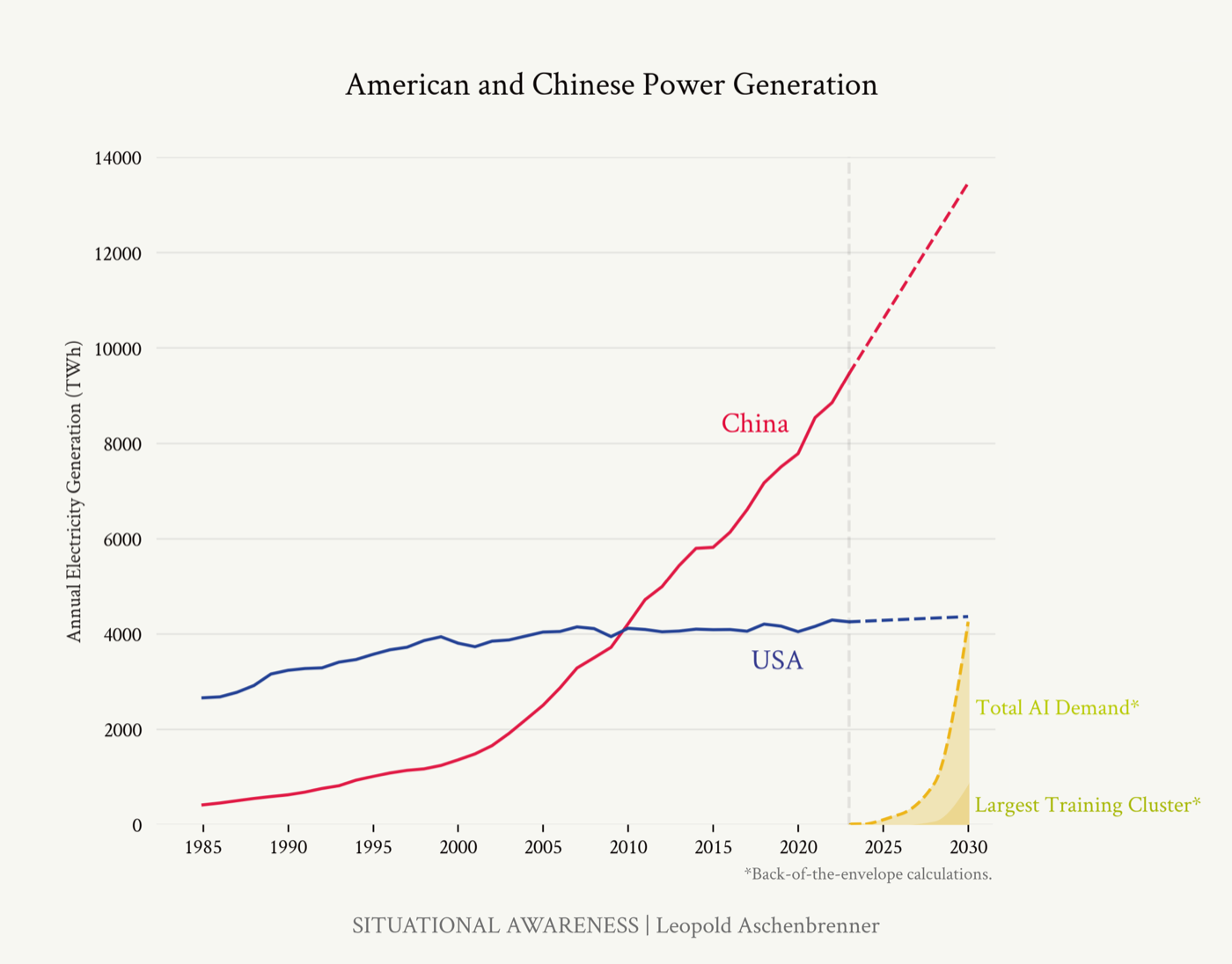
**1b. Outbuilding the US: **The binding constraint on the largest training clusters won’t be chips, but industrial mobilization—perhaps most of all the 100GW of power for the trillion-dollar cluster. But if there’s one thing China can do better than the US it’s *building stuff. *
In the last decade, China has roughly built as much new electricity capacity as *the entire US capacity (while US capacity has remained basically flat). *In the US, these things get stuck in environmental review, permitting, and regulation for a decade first. It thus seems quite plausible that China will be able to simply outbuild the US on the largest training clusters.
*The AI power buildout for 2030 seems much more doable for China than the US. Based on earlier estimates from Racing to the Trillion-Dollar Cluster.*
2. **Algorithms **
As discussed extensively in Counting the OOMs, scaling compute is only part of the story: algorithmic advances probably contribute at least half of AI progress. We’re developing the key algorithmic breakthroughs for AGI right now (essentially the EUV of algorithms because of the data wall).
By default, I expect Western labs to be well ahead; they have much of the key talent, and in recent years have developed all of the key breakthroughs. The size of the advantage may well be equivalent to a 10x (or even 100x) bigger cluster in a few years; this would provide the United States with a reasonably comfortable lead.
And yet, on the current course, we will completely surrender this advantage: as discussed extensively in the security section, the current state of security essentially makes it trivial for China to infiltrate American labs. And so, unless we lock down the labs very soon, I expect China to be able to simply steal the key algorithmic ingredients for AGI, and match US capabilities.9
(Even worse, if we don’t improve security, there’s an even more salient path for China to compete. They won’t even need to train their own AGI: they’ll just be able to steal the AGI weights directly. Once they’ve stolen a copy of the automated AI researcher, they’ll be off to the races, and can launch their own intelligence explosion. If they’re willing to apply less caution—both good caution, and unreasonable regulation and delay—than the US, they could race through the intelligence explosion more quickly, outrunning us to superintelligence.)
To date, US tech companies have made a much bigger bet on AI and scaling than any Chinese efforts; consequently, we are well ahead. But counting out China now is a bit like counting out Google in the AI race when ChatGPT came out in late 2022. Google hadn’t yet focused their efforts in an intense AI bet, and it looked as though OpenAI was far ahead—but once Google woke up, a year and half later, they are putting up a very serious fight. China, too, has a clear path to putting up a very serious fight. If and when the CCP mobilizes in the race to AGI, the picture could start looking very different.
Perhaps the Chinese government will be incompetent; perhaps they decide AI threatens the CCP and impose stifling regulation. But I wouldn’t count on it.
I, for one, think we need to operate under the assumption that we will face a full-throated Chinese AGI effort. As every year we get dramatic leaps in AI capability, as we start seeing early automation of software engineers, as AI revenue explodes and we start seeing $10T valuations and trillion-dollar cluster buildouts, as a broader consensus starts to form that we are on the cusp of AGI—the CCP will take note. Much as I expect these leaps to wake up the USG to AGI, I would expect it to wake up the CCP to AGI—and to wake up to what being behind on AGI would mean for their national power.
They will be a formidable adversary.
The authoritarian peril
A dictator who wields the power of superintelligence would command concentrated power unlike any we’ve ever seen. In addition to being able to impose their will on other countries, they could enshrine their rule internally. Millions of AI-controlled robotic law enforcement agents could police their populace; mass surveillance would be hypercharged; dictator-loyal AIs could individually assess every citizen for dissent, with advanced near-perfect lie detection rooting out any disloyalty.
Most importantly, the robotic military and police force could be wholly controlled by a single political leader, and programmed to be perfectly obedient—no more risk of coups or popular rebellions.
Whereas past dictatorships were never permanent, superintelligence could eliminate basically all historical threats to a dictator’s rule and lock in their power (cf value lock-in). If the CCP gets this power, they could enforce the Party’s conception of “truth” totally and completely.
To be clear, I don’t just worry about dictators getting superintelligence because “our values are better.” I believe in freedom and democracy, strongly, because I don’t know what the right values are. In the long arc of history, “time has upset many fighting faiths.” I believe we should place our faith in mechanisms of error correction, experimentation, competition, and adaption.
Superintelligence will give those who wield it the power to crush opposition, dissent, and lock in their grand plan for humanity. It will be difficult for anyone to resist the terrible temptation to use this power. I hope, dearly, that we can instead rely on the wisdom of the Framers—letting radically different values flourish, and preserving the raucous plurality that has defined the American experiment.
At stake in the AGI race will not just be the advantage in some far-flung proxy war, but whether freedom and democracy can survive for the next century and beyond. The course of human history is as brutal as it is clear. Twice in the 20th century tyranny threatened the globe; we must be under no delusion that this threat is banished forever. For many of my young friends, freedom and democracy feel like a given—but they are not. By far the most common political system in history is authoritarianism.10
I genuinely do not know the intentions of the CCP and their authoritarian allies. But, as a reminder: the CCP is a regime founded on the continued worship of perhaps the greatest totalitarian mass-murderer in human history (“with estimates ranging from 40 to 80 million victims due to starvation, persecution, prison labor, and mass executions”); a regime that recently put a million Uyghurs in concentration camps and crushed a free Hong Kong; a regime that systematically practices mass surveillance for social control, both of the new-fangled (tracking phones, DNA databases, facial recognition, and so on) and the old-fangled (recruiting an army of citizens to report on their neighbors) kind; a regime that ensures all text messages passes through a censor, and that goes so far to repress dissent as to pull families into police stations when their child overseas attends a protest; a regime that has cemented Xi Jinping as dictator-for-life; a regime that touts its aims to militarily crush and “reeducate” a free neighboring nation; a regime that explicitly seeks a China-centric world order.
*The free world must prevail over the authoritarian powers in this race. *We owe our peace and freedom to American economic and military preeminence. Perhaps even empowered with superintelligence, the CCP will behave responsibly on the international stage, leaving each to their own. But the history of dictators of their ilk is not pretty. If America and her allies fail to win this race, we risk it all.
Maintaining a healthy lead will be decisive for safety
It is the cursed history of science and technology that as they have unfolded their wonders, they have also expanded the means of destruction: from sticks and stones, to swords and spears, rifles and cannons, machine guns and tanks, bombers and missiles, nuclear weapons. The “destruction/$” curve has consistently gone down as technology has advanced. We should expect the rapid technological progress post-superintelligence to follow this trend.
Perhaps dramatic advances in biology will yield extraordinary new bioweapons, ones that spread silently, swiftly, before killing with perfect lethality on command (and that can be made extraordinarily cheaply, affordable even for terrorist groups). Perhaps new kinds of nuclear weapons enable the size of nuclear arsenals to increase by orders of magnitude, with new delivery mechanisms that are undetectable. Perhaps mosquito-sized drones, each carrying a deadly poison, could be targeted to kill every member of an opposing nation. It’s hard to know what a century’s worth of technological progress would yield—but I am confident it would unfold appalling possibilities.
Humanity barely evaded self-destruction during the Cold War. On the historical view, the greatest existential risk posed by AGI is that it will enable us to develop extraordinary new means of mass death. This time, these means could even proliferate to become accessible to rogue actors or terrorists (especially if, as on the current course, the superintelligence weights aren’t sufficiently protected, and can be directly stolen by North Korea, Iran, and co.).
North Korea already has a concerted bioweapons program: the US assesses that “North Korea has a dedicated, national level offensive program” to develop and produce bioweapons. It seems plausible that their primary constraint is how far their small circle of top scientists has been able to push the limits of (synthetic) biology. What happens when that constraint is removed, when they can use millions of superintelligences to accelerate their bioweapons R&D? For example, the US assesses that North Korea currently has “limited ability” to genetically engineer biological products—what happens when that becomes unlimited? With what unholy new concoctions will they hold us hostage?
Moreover, as discussed in the superalignment section, there will be extreme safety risks around and during the intelligence explosion—we will be faced with novel technical challenges to ensure we can reliably trust and control superhuman AI systems. This very well may require us to slow down at some critical moments, say, delaying by 6 months in the middle of the intelligence explosion to get additional assurances on safety, or using a large fraction of compute on alignment research rather than capabilities progress.
Some hope for some sort of international treaty on safety. This seems fanciful to me. The world where both the CCP and USG are AGI-pilled enough to take safety risk seriously is also the world in which both realize that international economic and military predominance is at stake, that being months behind on AGI could mean being permanently left behind. If the race is tight, any arms control equilibrium, at least in the early phase around superintelligence, seems extremely unstable. In short, ”breakout” is too easy: the incentive (and the fear that others will act on this incentive) to race ahead with an intelligence explosion, to reach superintelligence and the decisive advantage, too great.11 At the very least, the odds we get something good-enough here seem slim. (How have those climate treaties gone? That seems like a dramatically easier problem compared to this.)
The main—perhaps the only—hope we have is that an alliance of democracies has a healthy lead over adversarial powers. The United States must lead, and use that lead to enforce safety norms on the rest of the world. That’s the path we took with nukes, offering assistance on the peaceful uses of nuclear technology in exchange for an international nonproliferation regime (ultimately underwritten by American military power)—and it’s the only path that’s been shown to work.
Perhaps most importantly, a healthy lead gives us room to maneuver: the ability to “cash in” parts of the lead, if necessary, to get safety right, for example by devoting extra work to alignment during the intelligence explosion.
The safety challenges of superintelligence would become extremely difficult to manage if you are in a neck-and-neck arms race. A 2 year vs. a 2 month lead could easily make all the difference. If we have only a 2 month lead, we have no margin at all for safety. In fear of the CCP’s intelligence explosion, we’d almost certainly race, no holds barred, through our own intelligence explosion—barreling towards AI systems vastly smarter than humans in months, without any ability to slow down to get key decisions right, with all the risks of superintelligence going awry that implies. We’d face an extremely volatile situation, as we and the CCP rapidly developed extraordinary new military technology that repeatedly destabilized deterrence. If our secrets and weights aren’t locked down, it might even mean a range of other rogue states are close as well, each of them using superintelligence to furnish their own new arsenal of super-WMDs. Even if we barely managed to inch out ahead, it would likely be a pyrrhic victory; the existential struggle would have brought the world to the brink of total self-destruction.
Superintelligence looks very different if the democratic allies have a healthy lead, say 2 years.12 That buys us the time necessary to navigate the unprecedented series of challenges we’ll face around and after superintelligence, and to stabilize the situation.
If and when it becomes clear that the US will decisively win, that’s when we offer a deal to China and other adversaries. They’ll know they won’t win, and so they’ll know their only option is to come to the table; and we’d rather avoid a feverish standoff or last-ditch military attempts on their part to sabotage Western efforts. In exchange for guaranteeing noninterference in their affairs, and sharing the peaceful benefits of superintelligence, a regime of nonproliferation, safety norms, and a semblance of stability post-superintelligence can be born.
In any case, as we go deeper into this struggle, we must not forget the threat of self-destruction. That we made it through the Cold War in one piece involved too much luck13—and the destruction could be a thousandfold more potent than what we faced then. A healthy lead by an American-led coalition of democracies—and a solemn exercise of this leadership to stabilize whatever volatile situation we find ourselves in—is probably the safest path to navigating past this precipice. But in the heat of the AGI race, we better not screw it up.
Superintelligence is a matter of national security
It is clear: AGI is an existential challenge for the national security of the United States. It’s time to start treating it as such.
Slowly, the USG is starting to move. The export controls on American chips are a huge deal, and were an incredibly prescient move at the time. But we have to get serious across the board.
The US has a lead. We just have to keep it. And we’re screwing that up right now. Most of all, we must rapidly and radically lock down the AI labs, before we leak key AGI breakthroughs in the next 12-24 months (or the AGI weights themselves). We must build the compute clusters in the US, not in dictatorships that offer easy money. And yes, American AI labs have a duty to work with the intelligence community and the military. America’s lead on AGI won’t secure peace and freedom by just building the best AI girlfriend apps. It’s not pretty—but we must build AI for American defense.
We are already on course for the most combustive international situation in decades. Putin is on the march in Eastern Europe. The Middle East is on fire. The CCP views taking Taiwan as its destiny. Now add in the race to AGI. Add in a century’s worth of technological breakthroughs compressed into years post-superintelligence. It will be the one of most unstable international situations ever seen—and at least initially, the incentives for first-strikes will be tremendous.14
There’s already an eerie convergence of AGI timelines (~2027?) and Taiwan watchers’ Taiwan invasion timelines (China ready to invade Taiwan by 2027?)—a convergence that will surely only heighten as the world wakes up to AGI. (Imagine if in 1960, the vast majority of the world’s uranium deposits were somehow concentrated in Berlin!) It seems to me that there is a real chance that the AGI endgame plays out with the backdrop of world war. Then all bets are off.
Next post in series*:* *** IV. The Project***
For example, Yi-Large seems to be a GPT-4-class model on LMSys, but that’s over a year after OpenAI released GPT-4.↩
Similarly, Qwen hugging face code cites Mistral a lot, and it seems that Chinese LLM dependence on American open-source is an explicit worry that has made its way to the Chinese Premier.↩
The Huawei Ascend 910B seems to cost around 120,000 yuan per card, or about $17k. This is produced on the SMIC 7nm node, while performing similarly to an A100. H100s are maybe ~3x better than A100s, while costing somewhat more ($20-25k ASP), suggesting only a ~2-3x cost increase for equivalent AI GPU performance for China right now.↩
For example, they’re still using Western HBM memory (which for some reason is not export controlled?), though CXMT is said to be sampling HBM next year.↩
Though, since they can still import other types of chips from the West, they could simply direct the entirety of their 7nm node to AI chips, making up for lower overall production.↩
Notably, even cybercriminals were able to hack Nvidia and get key GPU design secrets. Moreover, TPUv6 designs were apparently among what was stolen by the recently-indicted Chinese national at Google.↩
For example, maybe these are 2x worse on perf/$ or perf/Watt. In turn, that also means to achieve the same overall datacenter performance, you need more power, and need more chips networked together, which also makes things more of a hassle.↩
Note that even 3x more on chips would be much less than that in terms of increase in datacenter costs. Actual logic fab costs are <5% of Nvidia GPU cost, and even considering memory and CoWoS it’s less than 20% of the Nvidia pricetag due to their margin. And even GPUs themselves tend to be only 50-60% of the cost of a datacenter. So 3x more expensive on the chip fab end might translate into much, much less than a 3x increase in overall cost. Even for 10x more expensive chips, it seems like China could stomach that without hugely increasing datacenter costs.↩
Some argue that even if China stole these secrets, they wouldn’t be able to compete because it requires tacit knowledge. I disagree. I think of this as having two layers. The bottom layer is the engineering prowess for large-scale training runs; these training runs can be hacky and delicate and requires tacit knowledge. But as I’ll discuss later, Chinese AI efforts have shown themselves perfectly capable of training large-scale models, and I think they will have this tacit knowledge indigenously. The top layer is the algorithmic recipe—things like model architecture, the right scaling laws, etc.—that could be conveyed in a one-hour call. These compute multipliers are usually discrete changes, meaning the underlying tacit knowledge for large-scale training runs should transfer. I don’t think “tacit knowledge” will be a decisive barrier for Chinese AGI efforts.↩
(Primarily monarchy.)↩
Consider the following comparison of unstable vs. stable arms control equilibria. 1980s arms control during the Cold War reduced nuclear weapons substantially, but targeted a stable equilibrium. The US and the Soviet Union still had 1000s of nuclear weapons. MAD was assured, even if one of the actors tried a crash program to build more nukes; and a rogue nation could try to build some nukes of their own, but not fundamentally threaten the US or Soviet Union with overmatch.
However, when disarmament is to very low levels of weapons or occurs amidst rapid technological change, the equilibrium is unstable. A rogue actor or treaty-breaker can easily start a crash program and threaten to totally overmatch the other players. Zero nukes wouldn’t be a stable equilibrium; similarly, this paper has interesting historical case studies (such as post-WWI arms limitations and the Washington Naval Treaty) where disarmament in similarly dynamic situations destabilized, rather than stabilized.
If mere months of lead on AGI would give an utterly decisive advantage, this makes stable disarmament on AI similarly difficult. A rogue upstart or a treaty-breaker could gain a huge edge by secretly starting a crash program; the temptation would be too great for any sort of arrangement to be stable.↩
It’s worth appreciating just how a big a deal 2 years is in terms of difference in AI capabilities. Given the already-rapid pace of AI progress today, and the even-more-rapid pace we should expect in an intelligence explosion, and the broader technological explosion post-superintelligence, a “even” a 2-year-lead would mean vast differences in capability.↩
Daniel Ellsberg recounts this rivetingly, as one of the nuclear war planners at RAND and in the national security apparatus at the time. ↩
Everyone will be racing to their own superintelligences, and there will be a limited window before someone ahead will have irreversibly pulled away. There will be a big incentive to try to disable the enemy superintelligence clusters before they’ve gained a sufficient physical advantage (e.g., using superintelligence to develop impenetrable missile defense or drone swarms) that leaves everyone else permanently in the dust.↩
超级智能将带来决定性的经济和军事优势。中国绝未出局。在通往 AGI(通用人工智能)的竞赛中,自由世界的生死存亡将系于一线。我们能否维持对威权强权的领先地位?我们又能否在途中避免自我毁灭?
本篇内容:
人类的历史就是战争的历史。除了短暂而不稳固的间歇期,世界上从未有过和平;在历史开始之前,残暴的争斗就已普遍存在且永无休止。……会不会有这样一种不比橙子更大的炸弹,被发现具有摧毁整片建筑群的秘密力量——不,甚至能汇聚一千吨火药之力,一举炸平一座城镇?
温斯顿·丘吉尔(Winston Churchill),《我们都该自杀吗?》("Shall We All Commit Suicide?")
超级智能将是人类有史以来开发出的最强大的技术——也是最强大的武器。它将带来决定性的军事优势,或许只有核武器能与之相比。威权政权可能利用超级智能征服世界,并在内部实施全面控制。流氓国家可能用它威胁毁灭他国。尽管许多人看衰中国,但一旦 CCP(中共)在 AGI 上醒悟,它就有明确的路径变得具有竞争力(至少在我们大幅改善美国 AI 实验室安全之前是这样,除非我们做到了)。
每一月的领先对安全同样至关重要。如果我们在激烈的赛跑中被锁定——民主盟友与威权对手各自以鲁莽的速度穿越本就岌岌可危的智能爆炸,被迫把一切谨慎抛诸脑后,唯恐对方先获得超级智能——我们将面临最大的风险。唯有民主盟友保持健康的领先,我们才能拥有足够的容错余地,去驾驭超级智能出现前后那段极度动荡而危险的时期。而唯有美国的领导,才是建立防扩散机制、规避超级智能将带来的自我毁灭风险的现实路径。
我们这一代人太轻易地把和平与自由的生活视为理所当然。而那些在科幻作品中颂扬 AGI 时代的人,也常常无视房间里的大象:超级智能事关国家安全,而美国必须取胜。
谁在超级智能上领先,谁就将拥有决定性的军事优势
超级智能并非其他任何技术——比如高超音速导弹、隐身技术等等——那样,美国与自由民主国家领先固然非常可取,但并非绝对必要。如果美国在一两项此类技术上落后,军事力量平衡仍可维持;这些技术举足轻重,但可以被其他领域的优势所抵消。
超级智能的到来将使我们置身于自原子时代开启以来从未见过的局面:拥有它的人将对没有它的人施加完全的支配。
我之前讨论过超级智能的巨大力量。它意味着拥有数十亿个自动化的科学家、工程师和技术人员,每一个都比最聪明的人类科学家还要聪明得多,日夜不停地狂热发明新技术。科技发展的加速将非同寻常。当超级智能被应用于军事技术的研发,我们可能迅速走完数十年的军事技术进步历程。
海湾战争,或:领先数十年的技术对军事力量意味着什么
海湾战争很好地说明了在军事技术上领先 20 到 30 年可以何等具有决定性。当时,伊拉克拥有世界第四大军队。就数量(兵力、坦克、火炮)而言,以美国为首的联军仅勉强与伊拉克相当(甚至处于劣势),而伊拉克还有充足的时间加固其防御(这种局面通常需要 3:1 甚至 5:1 的兵力优势才能击溃)。
但以美国为首的联军在仅仅 100 小时的地面战争中就摧毁了伊拉克军队。联军阵亡人数仅 292 人,而伊拉克方面死亡 2 万至 5 万人,另有数十万人受伤或被俘。联军仅损失 31 辆坦克,而伊拉克超过 3,000 辆坦克被摧毁。
技术上的差距并非神一般的、不可理解的东西,但它彻底而完全地具有决定性:制导与灵巧弹药、早期版本的隐身技术、更好的传感器、更好的坦克瞄准镜(能在夜间和沙尘暴中看得更远)、更好的战斗机、侦察优势,等等。
(举一个更近的例子:回想伊朗向以色列发射 300 枚导弹的大规模攻击,其中“99%”被以色列、美国及盟国更优越的导弹防御系统拦截。)
在超级智能上领先一两年或三年,可能意味着如同美国联军在海湾战争中对伊拉克所拥有的那种绝对具有决定性的军事优势。军事力量平衡将被彻底重塑,这正处在紧要关头。
想象一下,如果我们用了不到十年就走完了 20 世纪的军事技术发展历程。我们会在几年内从马匹、步枪和堑壕,进到现代的坦克部队;再过几年,进到超音速战斗机、核武器和洲际弹道导弹的庞大战队;再过几年,进到能赶在敌人意识到你就在那里之前就将其摧毁的隐身与精确打击能力。
这就是超级智能出现时我们将面临的局面:一个世纪的军事技术进步被压缩到不足十年。我们将看到能够瘫痪对手大部分军事力量的超人级黑客攻击、机器人大军和自主无人机蜂群,但更重要的是我们尚无法想象的全新范式,以及破坏力提升千倍的新式大规模杀伤性武器(还有新的 WMD 防御手段,比如无法穿透的导弹防御,它会迅速而反复地颠覆威慑均衡)。
而且这不只是技术进步。随着我们攻克机器人技术,劳动力将完全自动化,也会推动更广泛的工业与经济爆炸。年增长率达到百分之十几是可能的;至多十年内,领先者的 GDP 将碾压落后者。快速倍增的机器人工厂不仅意味着巨大的技术优势,也意味着在纯粹物质生产上占主导地位的生产能力。想想数百万枚导弹拦截器;数十亿架无人机;等等。
当然,我们不知道科学的极限,也不知道有多少摩擦会拖慢进程。但决定性军事优势并不需要神一般的进步。而十亿个超级智能科学家将能做成太多事情。显然,不出几年,超级智能出现之前的军事力量就会变得无可挽回地落后。
即使面对核威慑,这种军事优势也将是决定性的
说得更清楚些:超级智能所带来的优势很可能大到足以先发制人地摧毁对手的核威慑。改进的传感器网络和分析能力可以定位哪怕是最安静的现役核潜艇(移动导弹发射车同理)。数百万或数十亿只老鼠大小的自主无人机,借助隐身技术的进步,可以渗透到敌后,秘密定位、破坏并"斩首"对手的核力量。改进的传感器、目标定位等可以大幅提升导弹防御能力(类似上面伊朗对以色列的例子);此外,如果发生工业爆炸,机器人工厂可以针对每一枚敌方导弹生产出数千枚拦截器。而这一切甚至还没有考虑全新的科学与技术范式(例如远程使所有核武器失效)。
这将毫无悬念。而且不仅仅是在"我们可以同归于尽"的核意义上毫无悬念,更是在能不付出重大伤亡就摧毁对手军事力量的意义上毫无悬念。在超级智能上领先几年就意味着完全的支配。
如果存在快速的智能爆炸,那么仅仅领先几个月就可能具有决定性:几个月可能就意味着大致人类水平的 AI 系统与显著超人水平的 AI 系统之间的差别。也许仅仅拥有这些初始超级智能——甚至在广泛部署之前——就足以构成决定性优势,例如通过能够关闭超级智能出现之前军队的超人级黑客能力、威胁要立即杀死每一位对手领导人、官员及其家人的规模较小的无人机蜂群,以及用 AlphaFold(蛋白质结构预测模型)式模拟开发的、可针对特定族群(例如任何非汉族人)的高级生物武器(或者干脆不向对手提供解药)。
中国可以具有竞争力
许多人似乎对中国与 AGI 掉以轻心。芯片出口管制已经削弱了他们,而领先的 AI 实验室在美国和英国——所以我们没什么好担心的,对吧?中国的 LLM(大语言模型)还不错——他们绝对有能力训练大模型!——但他们充其量只能与美国实验室的第二梯队相提并论。1 而且即便是中国模型,往往也只是美国开源成果的翻版(例如,Yi-34B 架构似乎基本上就是 Llama2 架构,只改了几行代码而已)。2 中国的深度学习过去比今天更重要(例如,百度发表过最早的现代 scaling law 论文之一),虽然中国在 AI 领域的论文发表数量超过美国,但近年来他们似乎没有推动任何关键突破。
然而,这一切只是序幕。如果且一旦 CCP 在 AGI 上醒悟,我们应当预料到 CCP 会为竞争付出非同寻常的努力。而且我认为中国有一条相当清晰的路径进入赛场:比美国建得更多,并且窃取算法。
1. 算力
**1a. 芯片:**中国现在似乎已经展示了制造 7nm 芯片的能力。虽然突破 7nm 将很困难(需要 EUV 极紫外光刻),但 7nm 已经足够了!作为参考,7nm 正是 Nvidia A100 所使用的制程。本土的华为昇腾 910B(Huawei Ascend 910B)基于中芯国际(SMIC)7nm 平台,在性能/价格上似乎仅比同等的 Nvidia 芯片差约 2-3 倍。3
SMIC 7nm 生产的良率以及中国在这方面能力的整体成熟度仍有争议,4 一个关键的未决问题是他们能以多大的产量生产这些 7nm 芯片。5 不过,似乎至少有很大的可能性,他们能在几年内大规模做到这一点。
AI 芯片的大部分增益来自为 AI 用例优化而改进的芯片设计(而中国很可能已经在通过台湾供应链窃取 Nvidia 的芯片设计)。6 7nm 对比 3nm 或 2nm,加上其晶圆厂总体上尚不成熟,可能会让中国的成本更高。7 但这绝非致命;在 7nm 工艺之上也能造出非常好的 AI 芯片。比如,我不会有很高的把握断言他们不能多花点钱、在几年内为 1000 亿美元以上乃至万亿美元级的训练集群获得充足算力。8
**1b. 超越美国的建设:*最大训练集群的约束瓶颈不会是芯片,而是工业动员——或许最主要的是万亿美元集群所需的 100GW 电力。但如果说有哪件事中国比美国做得更好,那就是搞建设*。
过去十年,中国新增的电力装机容量大约相当于美国的全部装机容量(而美国的装机容量基本持平)。在美国,这些项目首先要被困在环境审查、许可和监管中长达十年。因此,中国很可能能在最大的训练集群上以建设速度直接超越美国。
到 2030 年的 AI 电力建设,对中国来说似乎远比美国可行。基于《竞逐万亿美元集群》(Racing to the Trillion-Dollar Cluster)中早前的估算。
2. 算法
正如《数 OOM》(Counting the OOMs)中详细讨论的,扩大算力只是故事的一部分:算法进步很可能贡献了 AI 进展的至少一半。我们此刻正在开发通往 AGI 的关键算法突破(由于数据墙,这些基本上就是算法领域的 EUV)。
按默认情形,我预计西方实验室会遥遥领先;他们拥有大部分关键人才,并且在近年取得了所有关键突破。优势的规模很可能相当于几年后一个 10 倍(甚至 100 倍)大的集群;这将为美国提供相当舒适的领先地位。
然而,按照目前的路线,我们将完全拱手让出这一优势:正如安全章节中详细讨论的,当前的安全状况实质上让中国可以轻而易举地渗透进美国实验室。因此,除非我们很快锁好实验室,我预计中国将能够直接窃取 AGI 的关键算法要素,并赶上美国的能力。9
(更糟的是,如果我们不改善安全,中国还有一条更突出的竞争路径。他们甚至不需要训练自己的 AGI:他们将能够直接窃取 AGI 权重。一旦他们窃取到自动化 AI 研究员的副本,他们就将直奔终点线,发起自己的智能爆炸。如果他们愿意比美国采取更少的谨慎——既包括合理的谨慎,也包括不合理的监管和拖延——他们就能更快地穿越智能爆炸,在超级智能上超过我们。)
迄今为止,美国科技公司在 AI 和扩展规模上的押注远远超过任何中国方面的努力;因此,我们遥遥领先。但现在就把中国排除在外,有点像 2022 年底 ChatGPT 问世时把谷歌排除在 AI 竞赛之外。谷歌当时尚未把精力集中到一场高强度的 AI 豪赌上,看起来 OpenAI 遥遥领先——但一旦谷歌醒悟,一年半之后,它就开始进行非常认真的反击。中国同样有一条清晰的路径进行非常认真的反击。如果且一旦 CCP 在 AGI 竞赛中动员起来,局面可能会开始变得非常不同。
也许中国政府会无能;也许他们会认定 AI 威胁到 CCP,从而施加令人窒息的监管。但我不会指望这一点。
就我而言,我认为我们必须在一个假设下行动:我们将面对一场全力投入的中国 AGI 努力。随着每一年 AI 能力都取得戏剧性的飞跃,随着软件工程师开始被早期自动化,随着 AI 收入爆发并开始出现 10 万亿美元($10T)的估值和万亿美元集群的建设,随着更广泛的共识开始形成——我们正处于 AGI 的门槛之上——CCP 都会注意到。正如我预期这些飞跃会唤醒美国政府(USG)认识到 AGI,我同样预期它会唤醒 CCP 认识到 AGI——并认识到在 AGI 上落后对他们的国家力量意味着什么。
他们将是可怕的对手。
威权的危险
一个掌握超级智能力量的独裁者将拥有我们从未见过的集中权力。除了能将意志强加于其他国家,他们还能在内部固化自己的统治。数百万个 AI 控制的机器人执法代理可以监控他们的民众;大规模监控将被超强化;忠于独裁者的 AI 可以逐一评估每个公民是否有异见,配合近乎完美的先进测谎技术铲除任何不忠。
最重要的是,机器人军队和警察部队可以完全由一位政治领袖控制,并被编程为绝对服从——不再有政变或民众起义的风险。
过去的独裁政权从来都不是永久的,而超级智能可以消除独裁者统治所面临的几乎所有历史性威胁,将其权力锁定(参见价值锁定)。如果 CCP 获得这种力量,他们就能彻底、完全地推行党所定义的"真理"。
说清楚,我担心的不只是独裁者获得超级智能,因为"我们的价值观更好"。我强烈地相信自由和民主,正是因为我不知道什么是正确的价值观。在历史的长弧中,"时间已经颠覆了许多好斗的信念"。我相信我们应该把信念寄托在纠错机制、实验、竞争和适应之上。
超级智能将赋予掌握它的人镇压反对派、异见并锁定其关乎人类的宏大计划的力量。任何人要抵抗使用这种力量的可怕诱惑都将非常困难。我深切地希望,我们能够转而依靠开国先贤们的智慧——让截然不同的价值观蓬勃发展,并保存定义美国实验的那种喧闹的多元性。
AGI 竞赛中岌岌可危的不仅是某场遥远代理战争中的优势,更是自由与民主能否在未来一个世纪乃至更久存续。人类历史的进程既残酷又清晰。20 世纪暴政曾两度威胁全球;我们绝不能幻想这一威胁已被永久驱除。对我许多年轻的朋友来说,自由与民主仿佛理所当然——但它们并非如此。历史上最常见的政治制度是威权主义。10
我确实不知道 CCP 及其威权盟友的意图。但请记住:CCP 是一个建立在持续崇拜也许是人类历史上最伟大的极权主义大屠杀者之上的政权("据估计,因饥荒、迫害、劳改营和集体处决而受害的人数在 4000 万到 8000 万之间");一个最近将一百万维吾尔人关进集中营、并压垮自由的香港的政权;一个系统性地实施大规模监控以进行社会控制的政权——既有新式的(追踪手机、DNA 数据库、人脸识别,等等),也有旧式的(招募一支公民大军举报邻居);一个确保所有短信都要经过审查、甚至压制异见到把海外参加抗议的孩子的家人带进警察局的政权;一个已经把习近平确立为终身独裁者的政权;一个宣扬要以军事力量粉碎并"再教育"一个自由邻国的政权;一个明确谋求以中国为中心的世界秩序的政权。
*在这场竞赛中,自由世界必须战胜威权强权。*我们的和平与自由归功于美国的经济和军事优势。也许即使获得超级智能,CCP 也会在国际舞台上负责任地行事,各安其分。但与他们同类独裁者的历史并不美好。如果美国及其盟友未能赢得这场竞赛,我们将拿一切去冒险。
保持健康的领先对安全具有决定性意义
科学与技术被诅咒的历史在于:当它们展现奇迹的同时,也扩大了毁灭的手段:从棍棒石头,到刀剑长矛、步枪大炮、机枪坦克、轰炸机导弹、核武器。"毁灭/美元"曲线随着技术进步一直在下降。我们应该预期超级智能之后的快速技术进步会延续这一趋势。
也许生物学的戏剧性进步会催生非同寻常的新型生物武器——无声而迅猛地传播,然后奉命以完美致命性击杀(而且可以做得极其便宜,连恐怖组织都负担得起)。也许新种类的核武器能使核武库的规模提升数个数量级,并配备无法探测的新型运载机制。也许蚊子大小的无人机,每架携带致命毒药,可以被锁定目标去杀死敌国的每一位成员。很难知道一个世纪的技术进步会带来什么——但我确信它会展开骇人的可能性。
人类在冷战期间勉强躲过了自我毁灭。从历史的视角看,AGI 带来的最大生存风险是它将使我们能够开发出非同寻常的新的大规模死亡手段。这一次,这些手段甚至可能扩散到流氓行为者或恐怖分子手中(尤其是如果按照当前的路线,超级智能权重没有得到充分保护、可以被朝鲜、伊朗之流直接窃取的话)。
朝鲜已经有一个协同的生物武器计划:美国评估称,"朝鲜有一项专门的、国家层面的进攻性计划"来开发和生产生物武器。似乎很可能,他们最主要的制约因素是其一小圈顶尖科学家能把(合成)生物学的边界推进多远。当这一制约被移除——当他们能用数百万个超级智能来加速其生物武器研发——会发生什么?例如,美国评估称,朝鲜目前"能力有限",无法对生物制品进行基因工程改造——当这变成无限时会发生什么?他们会用什么邪恶的新配方来挟持我们?
此外,正如超对齐章节所讨论的,在智能爆炸期间及其前后将存在极端的危险风险——我们将面临新的技术挑战,以确保我们能可靠地信任和控制超人 AI 系统。这很可能要求我们在某些关键时刻放慢速度,比如说,在智能爆炸中途推迟 6 个月以获取额外的安全保证,或者将很大一部分算力用于对齐研究而不是能力进展。
有些人希望达成某种关于安全的国际条约。在我看来这近乎空想。那个 CCP 与美国政府(USG)都对 AGI 认真到足以严肃对待安全风险的世界,也是双方都意识到国际经济与军事主导权岌岌可危、在 AGI 上落后数月可能意味着被永久甩下的世界。如果竞赛激烈,任何军备控制均衡——至少在超级智能出现前后的早期阶段——似乎都极不稳定。简言之,"突围"太容易了:抢先发动智能爆炸、抵达超级智能并获得决定性优势的动机(以及对别人会据此行事的恐惧)都太过强烈。11 至少,我们能得到足够好的东西的几率似乎微乎其微。(那些气候条约进展如何?那看起来是个比这容易得多的问题。)
我们最主要的——也许是唯一的——希望是,一个民主国家的联盟对敌对强权保持健康的领先。美国必须领导,并利用这种领先把安全规范施加于世界其他地区。这就是我们对待核武器的路径:以在和平利用核技术方面提供援助,换取一个国际防扩散体制(最终由美国军事力量作为后盾)——这也是唯一被证明有效的路径。
也许最重要的是,健康的领先给我们腾挪的空间:必要时"兑现"部分领先,把安全做对,例如在智能爆炸期间投入额外的工作到对齐上。
如果你身处一场并驾齐驱的军备竞赛,超级智能的安全挑战将变得极其难以管理。领先 2 年对比领先 2 个月,可能轻松造成天壤之别。如果我们只有 2 个月的领先,我们在安全上就毫无余地。出于对 CCP 智能爆炸的恐惧,我们几乎肯定会毫无顾忌地冲过自己的智能爆炸——在几个月内一头扎向远比人类聪明的 AI 系统,没有任何能力放慢脚步把关键决策做对,随之而来的是超级智能失控的所有风险。我们将面临一个极度动荡的局面,因为我们与 CCP 都在快速开发不断颠覆威慑均衡的非凡新军事技术。如果我们的机密和权重没有被锁好,那甚至可能意味着其他一系列流氓国家也逼近了,各自用超级智能装备自己新的超级大规模杀伤性武器库。即便我们勉强险胜,那也很可能是惨胜;这场生存斗争会把世界带到彻底自我毁灭的边缘。
如果民主盟友保持健康的领先,比如说 2 年,超级智能的样子就会截然不同。12 那会为我们买到必要的时间,去应对超级智能出现前后及之后我们将面临的一系列前所未有的挑战,并稳定局势。
如果且一旦美国将决定性获胜这一点变得清晰,那才是我们向中国和其他对手提出交易的时候。他们会知道自己赢不了,于是会明白唯一的选项是坐到谈判桌前来;而我们也宁愿避免一场狂热的对峙,或他们孤注一掷地以军事手段破坏西方努力的企图。以保证不干涉他们的事务、分享超级智能的和平惠益为交换,一个防扩散、安全规范以及在超级智能之后重现某种稳定的体制便可以诞生。
无论如何,当我们深入这场斗争,我们绝不能忘记自我毁灭的威胁。我们完好无损地挺过冷战,涉及了太多运气13——而毁灭的烈度可能是我们当时面对的千倍。美国领导的民主国家联盟保持健康的领先——并郑重行使这一领导力以稳定我们所处的任何动荡局面——很可能是穿越这道悬崖的最安全路径。但在 AGI 竞赛的白热化中,我们最好不要搞砸。
超级智能事关国家安全
这是清楚的:AGI 对美国国家安全是一个生存级的挑战。是时候开始这样对待它了。
美国政府正在缓慢行动。对美制芯片的出口管制意义重大,在当时是极富远见的一步。但我们必须在各个层面都认真起来。
美国确实有领先优势。我们只需要保持住。而我们此刻正在搞砸它。最重要的是,我们必须迅速而彻底地锁好 AI 实验室,抢在未来 12-24 个月泄露出关键 AGI 突破(或 AGI 权重本身)之前。我们必须在美国建设算力集群,而不是在那些提供轻松赚钱机会的独裁国家。是的,美国 AI 实验室有责任与情报界和军方合作。美国在 AGI 上的领先不会仅仅靠构建最好的 AI 女友应用来保障和平与自由。这不漂亮——但我们必须为美国的国防构建 AI。
我们已经走在通向数十年来最具爆炸性的国际局势的轨道上。普京正在东欧推进。中东燃起战火。CCP 把拿下台湾视为其天命。现在再加上 AGI 竞赛。再加上超级智能之后把相当于一个世纪的技术突破压缩进几年。这将成为有史以来最不稳定的国际局势之一——而且至少在一开始,先发制人打击的动机将极其强烈。14
AGI 时间线(约 2027 年?)与台湾观察人士的攻台时间线(中国到 2027 年或将准备好入侵台湾?)之间已经出现一种诡异的趋同——随着世界醒悟到 AGI,这种趋同无疑只会进一步加剧。(想象一下,如果在 1960 年,世界上绝大多数的铀矿都以某种方式集中在柏林!)在我看来,AGI 终局之战以世界大战为背景上演,有真实的可能性。到那时,一切赌注都失效了。
系列下一篇文章:第四部分:该项目(IV. The Project)
例如,Yi-Large 在 LMSys 上似乎是 GPT-4 级别的模型,但那是在 OpenAI 发布 GPT-4 一年多之后。
同样,Qwen 的 Hugging Face 代码大量引用 Mistral,而且中国 LLM 对美国开源软件的依赖似乎是一个明确的担忧,这一担忧已经传到中国总理那里。
华为昇腾 910B 每张卡似乎约 120,000 元人民币,约合 1.7 万美元($17k)。它生产于 SMIC 7nm节点,性能与 A100 相近。H100 大约比 A100 好 3 倍,同时价格略高(均价 $20-25k),这表明中国目前为同等 AI GPU 性能大约要多付 2-3 倍成本。↩
例如,他们仍在用西方的 HBM(高带宽内存)(出于某种原因不受出口管制?),尽管据说长鑫存储(CXMT)明年将开始送样 HBM。↩
不过,由于他们仍可从西方进口其他类型的芯片,他们可以直接把整个 7nm 节点产能用于 AI 芯片,以弥补总体产量较低的不足。↩
值得注意的是,连网络罪犯都能黑入 Nvidia并窃取关键的 GPU 设计机密。此外,最近被起诉的谷歌中国籍员工窃取的东西中显然就包括 TPUv6 设计。↩
例如,这些芯片在性能/价格或性能/功耗上可能差 2 倍。相应地,这意味着要达到同样的整体数据中心性能,需要更多电力,需要把更多芯片联网,这也让事情更加麻烦。↩
注意,即便芯片贵 3 倍,对数据中心成本的增加也远小于 3 倍。实际逻辑晶圆制造成本不到 Nvidia GPU 成本的 <5%,即便算上内存和 CoWoS(晶圆级封装),也因其利润率而不到 Nvidia 售价的 20%。而且 GPU 本身往往只占数据中心成本的 50-60%。所以芯片制造端贵 3 倍可能转化为远小于 3 倍的总成本增加。即便芯片贵 10 倍,中国似乎也能承受,而不至于大幅推高数据中心成本。↩
有人认为,即使中国窃取了这些秘密,他们也无法竞争,因为这需要隐性知识(tacit knowledge)。我不同意。我认为这分两层。底层是进行大规模训练运行的工程能力;这些训练运行可能又 hacky 又精细,需要隐性知识。但正如我后面会讨论的,中国的 AI 努力已证明完全有能力训练大规模模型,我认为他们会本土掌握这种隐性知识。顶层是算法配方——比如模型架构、正确的 scaling law 等等——一通一小时的电话就能讲清楚。这些算力倍增通常是离散的变化,意味着大规模训练运行的底层隐性知识应当可以迁移。我不认为"隐性知识"会成为中国 AGI 努力的决定性障碍。↩
(主要是君主制。)↩
考虑一下不稳定与稳定的军备控制均衡的对比。1980 年代冷战期间的军备控制大幅削减了核武器,但它瞄准的是一个稳定的均衡。美国和苏联仍有数千件核武器。即便其中一方试图通过紧急计划制造更多核武器,相互确保摧毁(MAD)也有保障;而流氓国家可以尝试自行制造一些核武器,但无法从根本上以压倒性优势威胁美国或苏联。
然而,当裁军低到极低的武器水平,或在快速技术变革中发生时,均衡就是不稳定的。一个流氓行为者或违约者可以轻易启动紧急计划,威胁要彻底压倒其他玩家。零核武器不会是一个稳定的均衡;同样,这篇论文有有趣的历史案例研究(如一战后的军备限制和《华盛顿海军条约》),在这些同样动态的情境中,裁军反而使局势失去稳定,而不是稳定下来。
如果仅仅领先几个月的 AGI 就能带来彻底的决定性优势,那么 AI 上的稳定裁军也同样困难。一个鲁莽的暴发户或违约者可以通过秘密启动紧急计划获得巨大优势;这种诱惑太大,任何安排都无法稳定。↩
值得体会一下 2 年在 AI 能力差异上是多大的事。考虑到今天已经很快的 AI 进展速度、我们在智能爆炸中应预期的更快速度,以及超级智能之后更广泛的技术爆炸,即便"仅仅"领先 2 年也会意味着能力上的巨大差异。↩
丹尼尔·埃尔斯伯格(Daniel Ellsberg)扣人心弦地讲述了这一点,他当时是兰德公司(RAND)和国家安全机构中的核战争规划者之一。
每个人都将竞逐自己的超级智能,在领先者不可逆转地绝尘而去之前会有一个有限的窗口。会存在巨大的动机,要在敌方超级智能集群获得足够的物理优势(例如用超级智能开发无法穿透的导弹防御或无人机蜂群,让其他所有人永远望尘莫及)之前设法将其摧毁。↩